
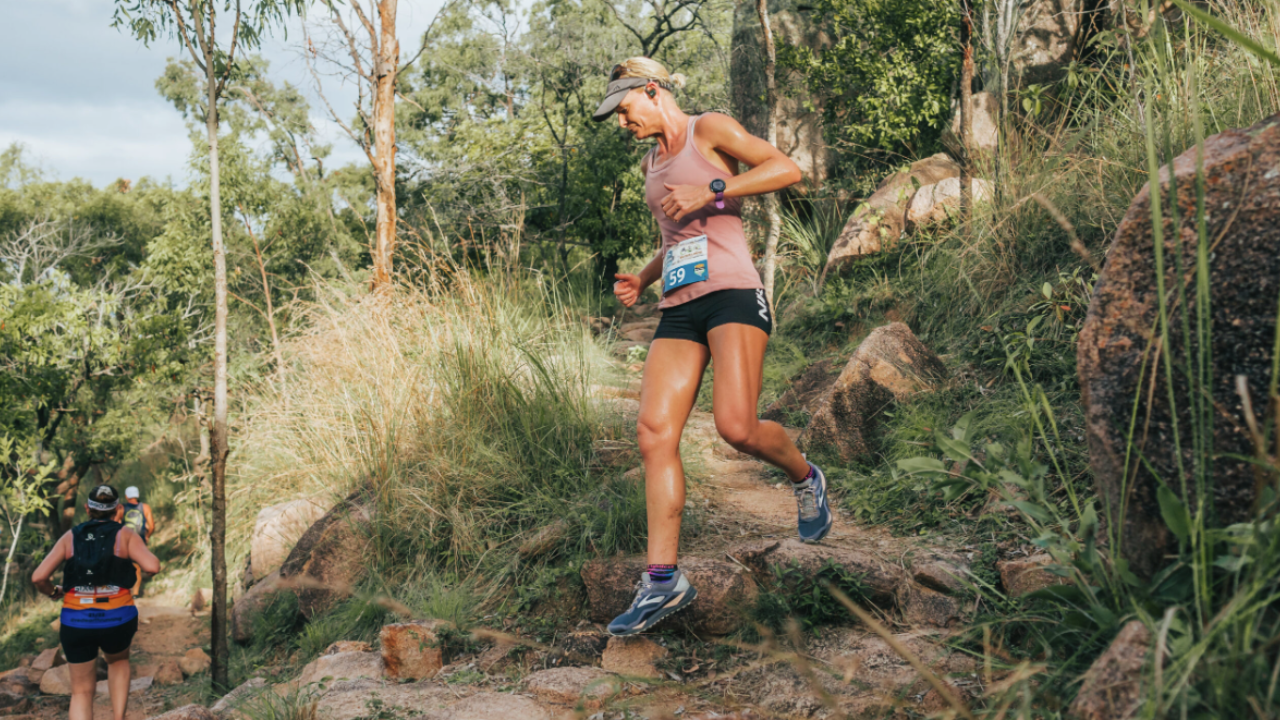
The cause of bone stress injuries
Trail Notes | Female Athlete Health
load, fuel and bone health, together
Bone Stress Injuries:
Training Load, Fuelling and Bone Health
Of all the injuries that can interrupt a season, a bone stress injury is one of the most disruptive. Understanding how it develops can help you make better decisions about training, fuel and recovery.
A bone stress injury, the family that runs from a bone stress reaction through to a stress fracture, is the kind of injury that can quietly end a build and, if the underlying contributors are missed, return again and again.
Bone stress injuries develop when repeated loading exceeds a bone's capacity to adapt and repair. Training progression matters, and so does the health of the bone receiving that load. Underfuelling, menstrual disturbances, low bone density and inadequate recovery can increase vulnerability.
These injuries are multifactorial, and they can occur in athletes with normal bone density and adequate nutrition. Prevention and recovery therefore require attention to both the training demand and the athlete's wider health.
A bone stress injury is a signal that the load has outpaced what the bone could repair.
Looking at training load, fuelling and bone health together gives you the best chance of understanding this injury and lowering the risk of the next one.
Trail Note · 01
What is actually happening in the bone
Bone is living, dynamic tissue. It is constantly being broken down and rebuilt in response to the loads you place on it. This is normal and healthy. Running, in a well-fuelled body, is part of what keeps bone strong.
A problem only appears when the rate of loading outpaces the rate of rebuilding. Microdamage then accumulates faster than the body can repair it. First comes a stress reaction, with swelling in the bone and pain when you press on it or load it. If the loading continues unchanged, that reaction can progress to a stress fracture. Symptoms can be subtle, and there is no dependable warning period, so focal bony pain deserves attention early.
Bone breaks down and rebuilds every day. Injury happens when loading outpaces repair, and several factors can tip that balance, including underfuelling.
Trail Note · 02
Why fuelling and hormonal health matter
When energy intake does not match the demands of training, the body may prioritise survival-critical functions over others, and bone remodelling can be affected. Energy deficiency can alter reproductive and metabolic hormones and impair bone health. These are important contributors to bone stress injury, not a universal explanation.
This sits at the centre of the Female Athlete Triad and the related picture of relative energy deficiency in sport. Low energy availability can contribute to menstrual disruption and lower bone density, and menstrual disruption warrants investigation, although it does not identify the cause by itself. It can also happen without an eating disorder and without an athlete realising she is underfuelled, for example when training load rises while food intake stays the same.
Research has linked absent or irregular periods with a higher risk of stress fracture and with lower bone density in runners. These are associations, and they sit alongside other contributors such as training load, recovery and underlying bone health.
How energy deficiency can affect bone
Not enough energy for your training load.
Reproductive and metabolic hormones can change, and periods can become irregular or stop.
Bone rebuilding can slow and bone can become more vulnerable.
A load the bone would normally handle may then be more likely to cause an injury.
Trail Note · 03
What can raise the risk
This is not only a young elite athlete's problem, and bone stress injuries are seen in recreational trail and ultra runners too. Several factors can contribute, and they often overlap.
Rapid training changes
Big jumps in weekly mileage, a build to a first ultra or a return after a break can outpace bone's ability to adapt.
Underfuelling
Training load rising without energy intake rising can contribute, especially when intake is restricted while building load.
Menstrual changes
Irregular cycles, or periods absent for more than 3 months, are worth proper assessment, not a convenient quiet. They do not identify the cause by themselves.
Perimenopause
Declining oestrogen can affect bone maintenance, and high load without adjusted fuel and recovery may add to the risk. The study discussed below did not include this life stage, so it is worth raising with your doctor.
Low vitamin D, calcium
These nutrients support bone health. Low levels can add to vulnerability and are worth checking with your doctor.
Short sleep and limited recovery
Inadequate recovery may contribute. In one 2024 study, women with a history of higher-risk injury more often reported shorter sleep, but an association does not show that sleep caused the injury.
That study included 45 premenopausal women aged 18 to 40, grouped by previous injury history. Measured vertical loading rates did not differ between the groups overall, while bone health did. Its design cannot show cause and effect, it does not mean impact or training load is unimportant, and it cannot tell us about runners in perimenopause or after menopause.
Trail Note · 04
How to recognise one
The classic signature is pain that is focal, you can put a finger on it, reproducible when you press on the bone, worse with weight-bearing running, and that does not fully settle between sessions. Early on it is often dismissed as shin pain or muscle tightness.
Features that can point to bone rather than soft tissue include tenderness directly over the bone, pain that builds with weight-bearing running, and pain that eases with rest but returns when you run. These features are not a reliable self-test, so if this sounds like what you are feeling, get it assessed. MRI can detect these injuries earlier than an X-ray, which may look normal in the early stages.
Where the injury sits matters. Some sites are recognised as higher risk for poor healing or progression to a complete fracture, and they need prompt, careful management. Your clinician will classify the site and set the plan.
Lower-risk sites
Sites that are not on the higher-risk list, such as the fibula, are generally classed as lower risk. The exact location within the shin or foot matters, so a general label like "shin" is not enough.
Lower-risk sites generally heal well with load management and nutritional support, but any bone stress injury still needs assessment and a plan.
Recognised higher-risk sites
The femoral neck, the anterior tibial cortex (the front of the shin bone), the navicular and the base of the 5th metatarsal.
These carry a greater chance of poor healing or progression to a complete fracture, and usually need more cautious management.
Pelvic and sacral injuries also deserve assessment, because the pain can be diffuse and mistaken for muscle. They are associated with impaired bone health, but they are not uniformly classed alongside femoral neck injuries, and classification varies between studies.
Stop and seek urgent review
Any focal, bony pain in the groin, hip, deep buttock, pelvis or sacrum that worsens with running and does not settle with normal soft-tissue care needs prompt medical assessment and imaging.
Please do not keep running on this kind of pain. Continuing to run on a femoral neck stress fracture can lead to a complete fracture and a far more serious injury. When in doubt at these sites, stop and get reviewed.
Trail Note · 05
Healing, and reducing the chance of the next one
Coming back well means protecting the injured bone, managing load, and looking at the factors that may have contributed. Your plan depends on the injury site and severity, and recovery time varies, so follow the timeline set by your clinician. Higher-risk sites can need restricted weight-bearing and medical clearance before running resumes.
Nutrition is an essential part of recovery, alongside protecting the bone and managing load. Enough total energy, adequate calcium and vitamin D, and enough protein give the bone what it needs to rebuild, and a doctor or sports dietitian can individualise this. Cross-training such as cycling or pool running may suit some injuries, but it depends on the injury site, your symptoms and your clinician's plan.
One honest, hopeful caveat. Restoring your period is a good sign, but it does not instantly restore bone, and rebuilding bone density after a spell of missed or irregular cycles can take months or years. That is one reason fuelling, protecting your cycle and building load gradually are worth attention before an injury happens.
Her Trails coaching cue
Fuel the training you are actually doing. Treat a missing period as a health signal worth assessing. Build load gradually and protect your recovery. These habits support bone health and can lower risk, but they cannot guarantee prevention.
Strong bones are supported by training load, fuelling, recovery and bone health working together.
Fuel. Sleep. A healthy cycle. Gradual load. The next good decision.
fuel the runner you are becoming
A gentle note: if food, fuelling or your relationship with your body feels hard, you are not alone and support exists. Her Trails coaches are not dietitians and do not manage clinical eating concerns, but we will always encourage you toward the right professional, your GP, a sports dietitian, or a qualified practitioner, who can help you fuel your running safely.
Written by the Her Trails coaching team
Trail Notes are evidence-informed coaching journals written for women who train, race and run on trails. Made to be absorbed in ten minutes and remembered for a season.
Evidence: Tenforde AS, et al. Factors associated with high-risk and low-risk bone stress injury in female runners. Orthopaedic Journal of Sports Medicine, 2024 (PMID 38779133). This cross-sectional study included 45 premenopausal women aged 18 to 40 and shows associations only, so it cannot establish causation or speak to perimenopausal or postmenopausal runners. International Delphi consensus on bone stress injuries in athletes. British Journal of Sports Medicine, 2024 (PMID 39638438). Williams NI, De Souza MJ, et al. 2025 update to the Female Athlete Triad Coalition Consensus Statement, Part 2. Sports Medicine, 2026 (PMID 41474492). De Souza MJ, et al. 2014 Female Athlete Triad Coalition Consensus Statement. BJSM, 2014 (PMID 24463911). Tomten SE, et al. Bone mineral density and menstrual irregularities in runners. Int J Sports Med, 1998 (PMID 9562216). This note is general coaching education, not individual medical advice. Suspected bone stress injury, irregular or absent periods, or concerns about fuelling all warrant assessment by a doctor or appropriate health professional.
Keep going with us