
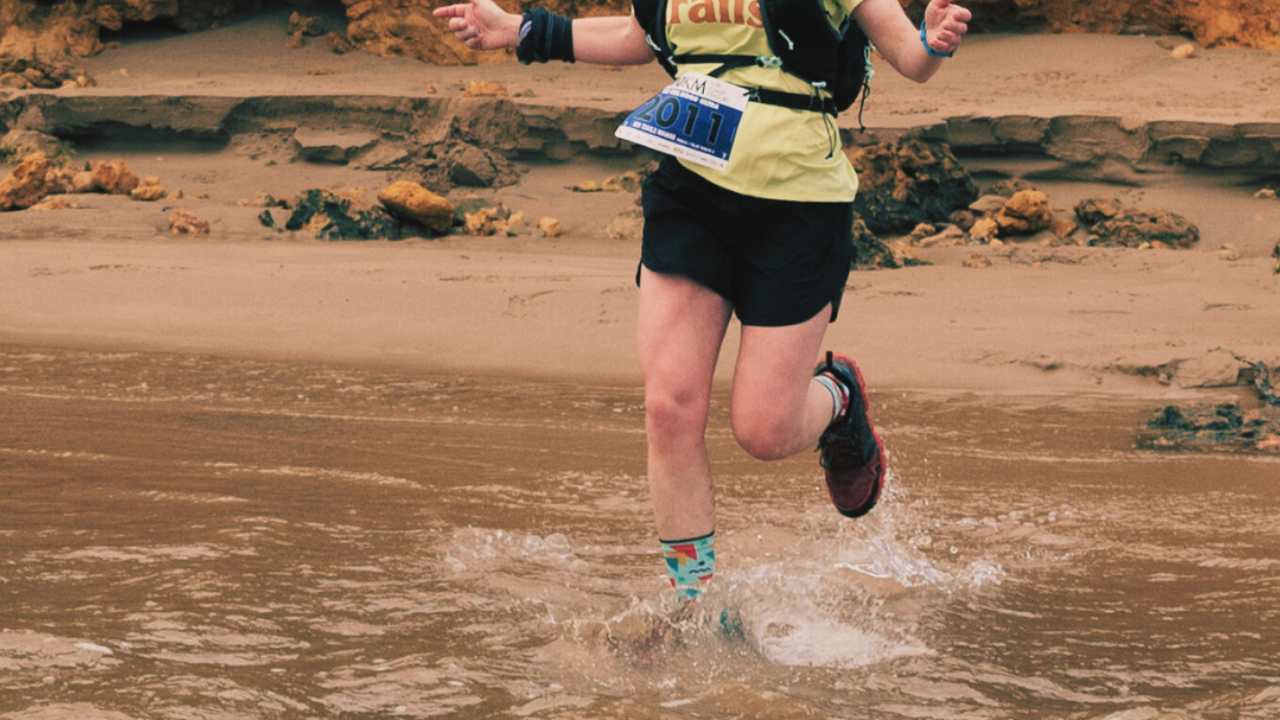
Shin Splints: Know the Signal
Trail Notes | Injury Awareness
listen early, return gently
Shin Splints
Know the Signal.
Shin pain is one of the most common things that interrupts a training block. Most of it responds to smart load management. Some of it should never be run through.
Somewhere in a build, many of us feel it: an ache along the inside of the shin that shows up at the start of a run, or the morning after a big week. We tend to call it shin splints, then wonder whether to push on, back off or get it checked.
This Trail Note pulls together what recent medical literature says, so you can tell the difference between a signal to adjust and a signal to stop.
Pain that stays after you stop, or that grows through a run, deserves a proper assessment.
Early action is almost always cheaper than late action.
Trail Note · 01
What "shin splints" actually means
The medical term is medial tibial stress syndrome, or MTSS: exercise-induced pain along the middle to lower inside edge of the shinbone. It is the most common cause of shin pain in runners, but it is not the only one.
The numbers vary by study and population. A 2023 clinical review in the Australian Journal of General Practice puts MTSS at 4 to 17% of athletes. Other reviews estimate that exercise-related shin pain makes up around 10 to 20% of all running injuries. Either way, this is common, which is exactly why it is easy to dismiss.
The useful point is that "shin pain" is a symptom with several possible causes, from an irritated bone lining (MTSS) to a bone stress reaction or stress fracture, to a pressure problem in the muscle compartments of the lower leg. They feel similar early on. They need different responses.
Common does not mean harmless. It means worth knowing how to read.
Trail Note · 02
Why this matters for us
Across the reviews, female sex is listed as a risk factor for MTSS, and female athletes were reported as more likely to develop it than male athletes. One review also notes that women are more prone to stress fractures, with dietary, biomechanical and hormonal factors all in the mix.
This is not a verdict on your body. The research does not say why in any detail, and most of the studies were done in road runners, military recruits and dancers, not trail athletes. What it gives us is a reason to take early shin pain seriously rather than assuming we can train through it.
The same reviews flag a few things worth raising with a GP or sports doctor if shin pain keeps returning: low calcium intake, vitamin D deficiency, low bone density and flat feet.
Trail Note · 03
What the 2025 research adds
Three 2025 papers are worth knowing. Two are surveys of athletes like us, and one is a new review of shin splints. All have limits, so we use them for context rather than firm conclusions.
Female trail runners
62 women reported 14.3 injuries per 1000 hours of running in the previous 12 months.
The lower limb was most affected, with the lower leg making up 12.2% of injuries.
Tendinopathy was the most common injury at 25.2%.
Bone injuries (fractures, stress fractures and other bone injuries) made up 13.9%.
Shin splints were named in only 1 of 115 injuries.
Ultra-endurance athletes
258 runners, cyclists and triathletes took part, and 33% were female.
50% reported an injury in the past 12 months.
Only 10% of injuries caused severe pain, and 7% led to stopping.
Knee, ankle and foot were the most common sites.
Injured and uninjured athletes did not differ by sex, age or training hours.
New review, 2025
A review in Medical Science (Ciszewski and colleagues) lists the familiar risk factors: rapid training increases, foot mechanics, nutrition, sex and BMI. It adds that MRI is sensitive for tibial bone changes. It is a student-authored narrative review with no new data, so we treat it as supporting, not leading.
What we take from it
Overuse, bone and tendon problems are all part of the picture for women who run long. Pain that stays in one spot and keeps building is worth assessing, not running through.
Two limits to keep in mind. Shin splints were rare in the female trail sample, so those studies cannot tell us how common they are for us or why. And only 51.6% of the women did any strength training, which is why the authors call for more research on load management and strength work in female trail runners.
Trail Note · 04
What tends to load the shin
The consistent theme is a mismatch between what the lower leg is asked to do and what it has adapted to. Bone and connective tissue need time to catch up with new demands. The literature points to a short list of common triggers.
Sudden jumps
A rapid increase in weekly volume, or adding extra run days quickly.
More hills or intensity
Longer distances, uphill running and added intensity all raise the demand on the lower leg.
Hard surfaces
Repeated impact on firm ground, especially when it is new to you.
Tired or unsuitable shoes
Worn footwear with limited shock absorption is repeatedly named as a contributor.
Previous shin pain
A history of MTSS and less running experience both show up as risk factors.
Training errors overall
One review cites training errors as responsible for around half of all running injuries.
For trail runners, the same logic applies when we add climbing, stairs, a new surface or a block of steep descents. That is our coaching reading of the research rather than a trail-specific finding, because the shin splints studies we reviewed did not look at trail running directly.
Trail Note · 05
How to read the signal
Shin splints typically show up as a dull ache along the inside of the shin that is sorest at the start of a run, may ease as you warm up, and often feels worse the next day. It usually settles with rest.
A stress fracture or a compartment problem can feel similar early on, so the pattern matters more than the label.
More typical of shin splints
A diffuse ache along a stretch of the inner shin.
Sorest early in the run, often easing as you warm up.
Worse the day after, then settling with rest.
Tender along the edge of the shinbone when pressed.
Get it assessed
Pain that continues after you stop, or shows up at rest.
Pain that builds through the run and lingers into daily life.
A small, specific spot of tenderness (a focal point under about 5 cm can suggest a bone problem).
Tightness or pressure that arrives at a predictable distance and eases within roughly 15 minutes of stopping.
Numbness, tingling or weakness in the lower leg or foot.
Her Trails coaching cue
If you are unsure which column you are in, that is your answer. Get it looked at before you train through it.
Trail Note · 06
What the research suggests you do
It's worth noting, the evidence for most shin splint treatments is limited, and the reviews we read say so. What follows is where they broadly agree.
Step 1
Reduce the load, do not just rest
Lower running volume, intensity and frequency. One review suggests cutting running by around half during the subacute phase (the intermediary recovery or healing stage between the sharp, initial acute phase and the long-term chronic phase), with low-impact cross-training such as cycling, swimming or an elliptical in the gaps. Another suggests avoiding rough, uneven terrain while it settles.
Step 2
Wait for pain-free before you build
The reviews recommend being pain-free before returning, and one suggests at least two weeks pain-free before restarting. If the same pain returns, stop, take a day or two, and restart at a lower level.
Step 3
Return in stages
A graduated walk-to-run progression over around 6 to 8 weeks is described for MTSS once you are pain-free. Increase one thing at a time. Healing can take months, in some cases up to 12.
Step 4
Build the support system
Calf strengthening, hip and glute strength, core stability and balance work are commonly recommended. Evidence for stretching alone is mixed. Cushioned, well-fitted shoes and, for some people, shock-absorbing insoles or orthotics may help.
Step 5
Manage symptoms sensibly
Ice and over-the-counter pain relief are widely used for comfort in the early phase. Check with a GP or pharmacist about what is right for you.
Step 6
Look after the mental load too
Long healing periods are hard on motivation and mood. The clinical review we used specifically calls out monitoring mental health when recovery drags on. Tell someone, including your coach.
Trail Note · 07
A coaching lens
Shins rarely break down because of one run. They break down because of a pattern, usually a few weeks of too much, too soon, on tired legs. That makes them one of the more preventable injuries we see.
Change one thing
When you add hills, distance, a new surface or new shoes, add one at a time.
Report early
Mention a niggle when it is a 2 out of 10, not a 7. Early adjustments are small adjustments.
Rotate and replace
Do not stretch a worn pair of shoes past its useful life.
Respect the return
Feeling better is not the same as being ready. Rebuild before you chase.
Her Trails coaching cue
Reduce the load before the pain reduces it for you.
Your shins are information. Treat them that way.
strong, patient, still running
Keep going with us
Run with us on Sundays and meet the women training beside you.
See what is coming next from Her Trails Coaching.