
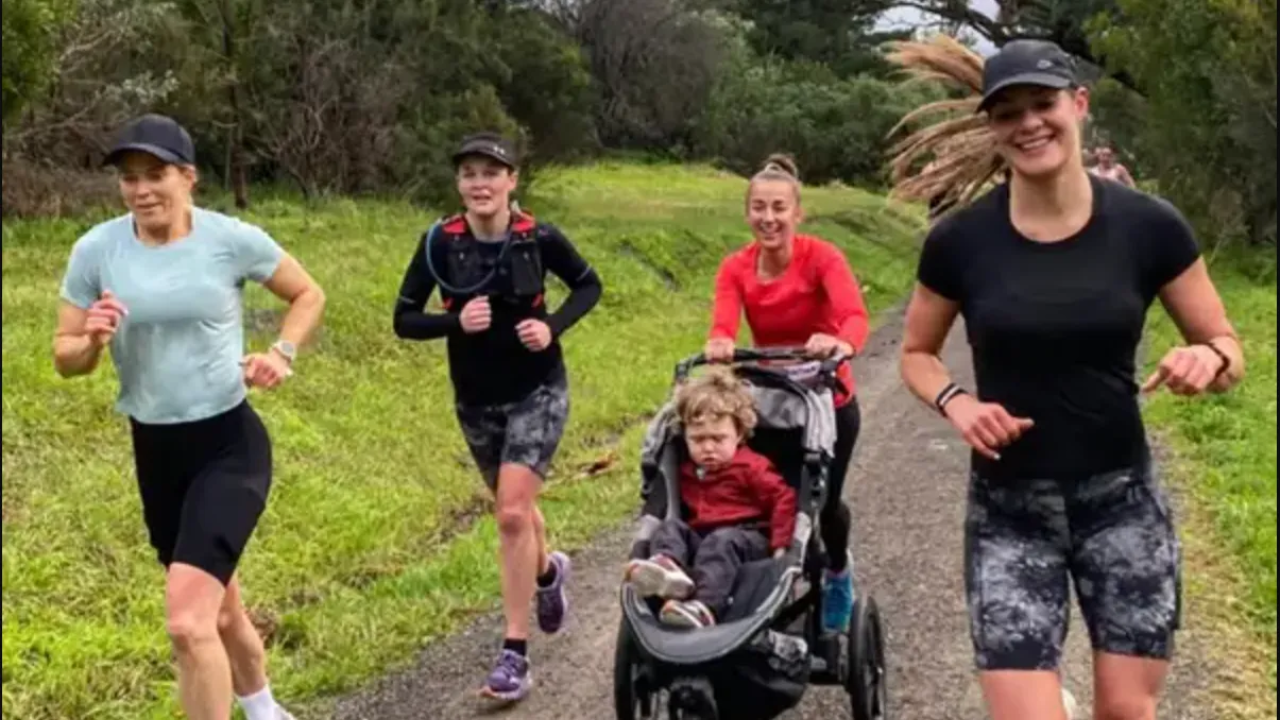
Running With a Pram, and With Patience
Trail Notes | Movement & Motherhood
for the runs that look nothing like the plan
Running With a Pram,
and With Patience
It is not the run you planned. It is the run that was possible.
Maybe your playlist is drowned out by crying. Maybe your usual easy pace feels very far away. Maybe you have stopped three times before the first kilometre, and you are wondering whether this counts as training at all.
It counts as movement. It counts as time outside. It counts as choosing a version of the day that includes you, too.
Pram running is not solo running with extra wheels. It is its own kind of practice.
Trail Note · 01
It asks different things of you
With a pram, your hands are occupied and your attention is shared. You are steering, braking, watching the surface ahead and responding to the small person along for the ride. Your stride, posture and rhythm will likely change. That is adaptation, not failure.
What may feel different
More deliberate posture: You may run more upright with shorter steps and less natural arm swing.
More stops and starts: Your session may be shaped by feeds, naps, nappy changes and the mood of the day.
More attention: You are reading both the terrain and your child’s cues, so the mental load is different.
More flexibility: Turning around early, walking a hill or calling it after 20 minutes can be excellent decision-making.
The goal is not to reproduce your pre-baby pace with a pram in front of you. The goal is to find a safe, sustainable rhythm for this season.
Trail Note · 02
Safety comes before the session
A pram that is safe for walking from birth is not automatically suitable for jogging. Start with the manufacturer’s manual for your specific model, including its guidance on the child’s age, developmental readiness, surface and front-wheel position. If you are unsure, speak with your child health professional.
Before every run
Check the manufacturer’s running guidance. Many jogging-pram brands distinguish clearly between walking and running, particularly for younger babies.
Use the five-point harness as instructed. Check the fit before you move.
Wear the wrist tether. It is there to reduce roll-away risk.
Use the brake whenever you stop. Even on apparently flat ground.
Check the weather. Heat, wind and direct sun affect your child differently to you.
Avoid covering the pram with a blanket or muslin to block the sun. It can restrict airflow and raise the temperature inside the pram. Use the fitted canopy as intended, seek shade, allow airflow and check your child regularly. Read Red Nose guidance.
For trail-adjacent movement, keep the route conservative: wide, smooth, predictable paths are usually a better choice than narrow singletrack, steep descents, cambers, loose rock or rough ground. Australian child-safety guidance specifically advises avoiding rough ground, kerbs and stairs with prams. Read the safety guide.
Trail Note · 03
Small adjustments make the run smoother
Choose an easy route first.
Begin with a familiar loop close to home. Flat, wide paths and smooth gravel are more forgiving than technical terrain.
Run by feel, not by pace.
Pram weight, wind, gradient and stop-start moments all affect speed. Let your breathing and overall effort set the day’s rhythm.
Keep your stride short and relaxed.
Avoid reaching forward with your feet. Stay tall, take smaller steps and give yourself more braking distance.
Switch hands when it feels safe.
On smooth, predictable ground, changing the hand guiding the pram can help reduce fatigue. Keep control as the priority and use two hands where the surface or descent requires it.
Plan for an early finish.
A useful pram run is one that ends before everyone is overstretched. A 20-minute loop can be the whole win.
Trail Note · 04
What to look for in a running pram
Choose a model that is explicitly designed and approved by its manufacturer for the kind of running you plan to do. Product features vary by model and country, so treat the manual and current local product information as the authority.
Useful features to consider
A stable, lockable or fixed front wheel: A key feature for running stability.
A wrist tether and reliable brake: Non-negotiable for control, especially on slopes.
Air-filled tyres and appropriate suspension: These can improve comfort over smoother unsealed paths, but do not make rough terrain risk-free.
A secure five-point harness: Use it exactly as directed.
A canopy with ventilation: Protection is important, but airflow and regular checks matter too.
A handlebar that suits your height: You should be able to move with a relaxed, upright posture rather than reaching or crowding your stride.
Trail Note · 05
Let the metric change
Pram running asks you to let go of some of the old measures. Pace may be slower. The route may be shorter. The session may not unfold in a neat, uploadable way.
That does not make it lesser. It makes it honest to the life you are living.
We got outside. We moved. We came home with a little more air in the day. That can be enough.
Reflection prompt
Where have I been measuring movement by the wrong metrics?
What could strength look like if presence, rather than pace, guided the run?
the kilometres may be slower, but the practice runs deep
Written by the Her Trails team
Her Trails is a place for women to move, explore and build a fuller relationship with themselves — through every season of life.
Keep going with us