
Run or Power-Hike? Making the Smart Call in an Ultra
Trail Notes | Race Day Strategy
Run or Power-Hike?
Making the Smart Call in an Ultra
Written For
Her Trails Coaching
Evidence Level
Coaching cue
Written By
Her Trails Coaching Team
Read Time
7 minutes
Walking is a genuine part of ultra running. It is not what happens when you are no longer capable of running. It is a deliberate way to manage effort, protect your legs and keep moving well across a long day.
But the answer is not simply always hike the climbs. If a hill is short or moderate, and you can run it while staying controlled and aerobic, running is often the right choice. It builds hill-running strength and economy, and it is faster. The skill is knowing when running a climb is giving you a return, and when it has become an unnecessarily expensive way to gain elevation. In an ultra, every surge has a consequence. The aim is to cover the whole course strongly, not win the first hill.
The central question is not can you run it. It is: can you run it sustainably, given how far you still have to go?
Trail Note 01: The Gradient Is a Guide, Not a Rule
A useful guide is to run the climbs you can hold at an effort you can sustain without gasping or needing to back off immediately, then switch to a power hike as soon as the gradient or duration tips you into work you cannot justify for the stage of the race. This will change across the day. A climb you can run comfortably at 10 kilometres may be better hiked at 35 kilometres, when your legs are carrying fatigue, you need to eat, or the temperature has climbed. The fact that you can run it is not always the reason you should.
As a rough terrain guide, many runners begin to find hiking more efficient somewhere around a 10 to 12 percent gradient, especially on sustained climbs. But it is not a rule. Trail surface, climb length, heat, fitness, fatigue and the terrain that follows all matter more than a number on a watch. Use the gradient as a guide, not a prescription: a short firm climb may be runnable, while a loose, hot or long climb may be smarter to hike well before that point.
Her Trails coaching cue: run what is runnable. Hike what is expensive. It is not about being slow. It is about spending less energy per vertical metre than running the same pitch would cost you.
Trail Note 02: The Strongest Strategy Is a Blend
Run flats, gentle rises and moderate climbs you can sustain aerobically. Power-hike long, steep or technical climbs with intent. Walk briefly to eat, drink, settle your breathing or regain control before fatigue compounds. Transition back to running smoothly when the terrain changes in your favour.
That last point matters. A strong hike is not a collapse. It is active, efficient movement that leaves you able to run again.
Trail Note 03: What Power-Hiking Should Feel Like
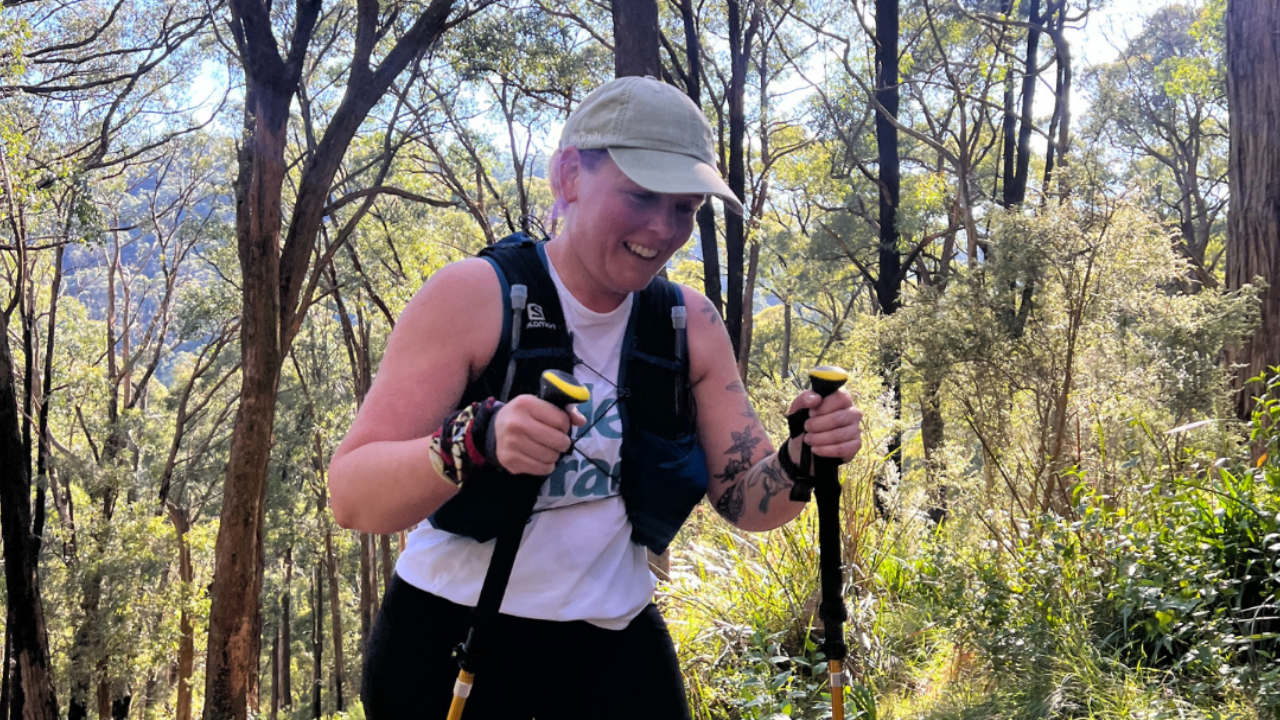
Power-hiking is purposeful. You are not strolling through a rest break, you are covering vertical metres at the lowest sustainable energy cost. Use short, quick steps. Stay tall through your torso with a slight forward lean from the ankles. Keep the arms active, and on steeper pitches, place your hands on your quads to help drive through the climb. Keep it to an effort you can sustain without gasping or needing to back off immediately. On steep hills, conversation can be an unreliable test, short phrases are more realistic.
The goal is to lose as little momentum as possible while keeping your aerobic system and legs out of the red. On very steep terrain, the difference between a hard hike and an inefficient run-shuffle can be small on the clock but enormous in what it costs. Saving that energy early is what allows you to keep running later.
Trained bodies tolerate long, low-intensity hiking time on feet with far less physiological cost than the equivalent hours running. Leaning into the walk on climbs is also protecting your legs for later in the race.
Trail Note 04: Train Both Capacities
If you want to become a stronger trail runner, do not hike every hill in training. You need to practise running moderate climbs to develop hill-specific strength, economy and confidence. You also need to practise hiking, because race-day hiking is a technical skill and a pacing decision.
Run the Moderate Pitches
While you can maintain a steady aerobic effort, build hill-running strength and economy.
Power-Hike the Steeper Ones
Practise on genuinely steep or sustained climbs so it becomes a skill, not something that just happens on the day.
Practise the Transition
Go from hike to jog without a surge at the crest. A clean transition saves energy every time you use it.
Fuel on the Hike
Take fuel during a planned hike section so eating becomes part of your rhythm rather than an interruption.
A weekly 45 to 90 minute session on hilly terrain can be hugely valuable. Hike the steep climbs with purpose, jog or run the runnable sections, and use the whole outing to learn what different gradients feel like in your body.
You might also include a focused uphill session: 6 to 10 repeats of 2 to 5 minutes uphill. Run the moderate gradients, power-hike the steeper ones, and recover easily on the way down. The aim is not to prove you can run every rep. It is to get better at selecting and executing the right mode of movement.
Trail Note 05: Make the Decision Before Fatigue Makes It for You
The best ultra runners are not necessarily the people who run every metre. They are the people who make calm, disciplined decisions before fatigue forces their hand.
Run the terrain where running is efficient. Hike the terrain where hiking is smarter. Fuel during the moments that allow it. Then return to running with control.
Her Trails coaching cue
Walking is not time lost. When it is deliberate, it is often how you save the race.
Run what is runnable. Hike what is expensive.