
How to Start Running With Others When You're Used to Running Alone
Trail Notes | Female Athlete Racing
for the woman who runs alone
Running Together
when you've always gone alone
You have built something real in your solo running. A ritual, a rhythm, a space where you don't have to explain yourself to anyone. And somewhere between loving that and knowing a group exists, there is a quiet, stubborn fear that joining one will cost you something you can't quite name.
Trail Note · 01
The Quiet You're Protecting
Solo running is not just the absence of other people. It is its own active thing, a mental reset that works precisely because nobody is watching. The resistance to group running is rarely laziness. It's almost always pace anxiety, the fear of being left behind, of slowing someone down, of the moment when the gap opens and you're the reason it did.
None of this is irrational. The quiet you've built in your solo runs deserves to be honoured. This piece isn't about convincing you to give it up. It's about showing you that group running doesn't ask for what you think it asks for, and that with the right group, you might discover something you didn't know you were missing.
"Your solo runs are not a consolation prize. They are a real and necessary relationship with your own body, one that most people never build."
That relationship is worth protecting. And it's also worth asking whether it's grown as large as it can grow on its own.
Trail Note · 02
Pace Anxiety: The Real Barrier
Ask any solo runner why they haven't joined a group, and pace anxiety sits somewhere near the top of the answer. The fear is almost always the same: I'm too slow. I'll hold them up. What's worth understanding is how thoroughly pace anxiety is built on an inaccurate picture of how good running groups actually function. In well-structured women's groups, there is no keeping up. There is the run, and everyone in it is welcome to move at their own pace within the group's range.
In a no-drop group, and all Her Trails runs operate this way, no one gets left behind. You are not a burden in this structure. You are exactly who the structure was built for.
Her Trails coaching cue
When you arrive, find the run leader and say this: "Hi, I'm new. I'm running around [your honest pace] per kilometre on flat, slower on hills. Can you point me toward who's running a similar pace?" That single sentence removes about 80% of the anxiety.
Trail Note · 03
What the Science Says About Running Together
In 1926, a German psychologist named Otto Köhler noticed something strange: rowers in a team consistently outperformed their expected individual contribution. When you run with someone of similar or slightly higher ability, you work at a higher intensity than you would alone, and you don't perceive it as harder.
On training consistency, the data is compelling: people who exercise with others are significantly more likely to show up consistently. A 2019 study published in Nature Communications found that social influence is the primary driver of exercise behaviour, not motivation, not willpower, not access. Whether the people around you run is the single biggest predictor of whether you run.
What research consistently shows
Runners who train with others work at a higher intensity without perceiving the effort as harder. Social influence is the strongest predictor of whether someone maintains an exercise habit. Post-run mood is measurably better after group exercise compared to equivalent solo effort. Women in group training environments are significantly more likely to take on goal races and keep training through major life transitions.
Trail Note · 04
How Her Trails Sunday Group Runs Work
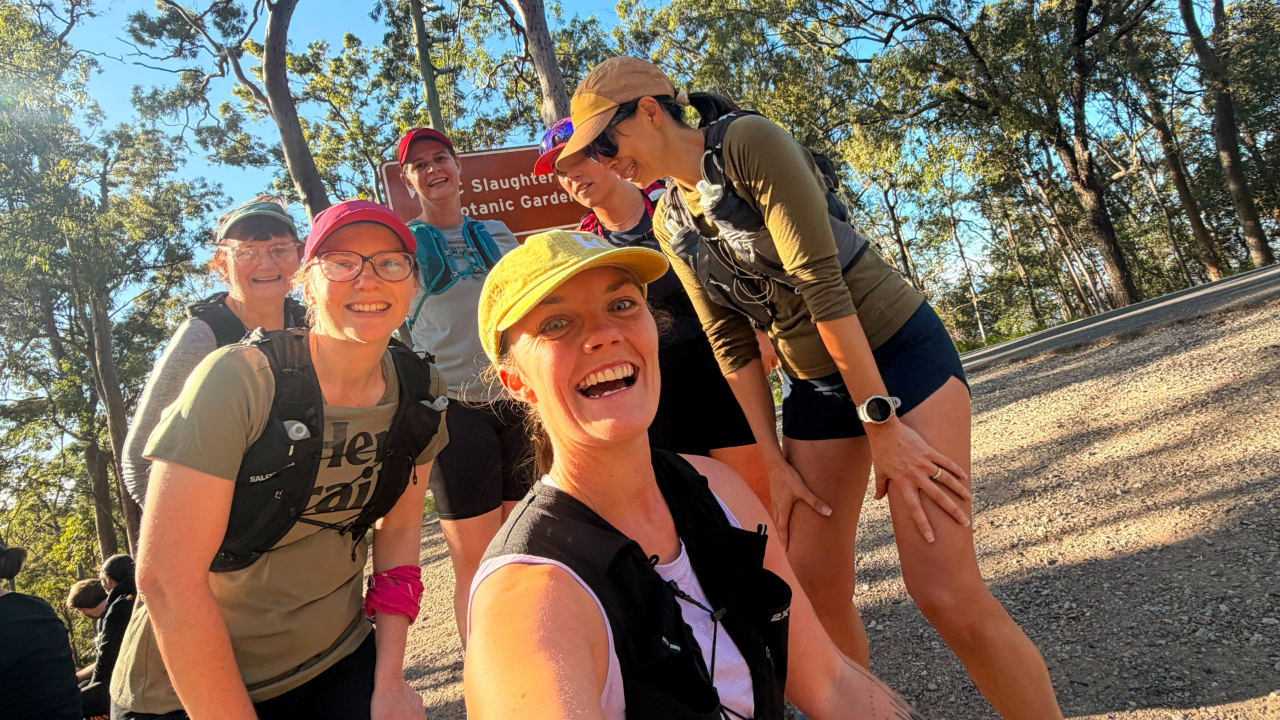
Her Trails Sunday group runs are women-only spaces built on one foundational commitment: nobody gets left behind. The no-drop philosophy is not aspirational language, it is the operational structure of every run. Routes are designed so that faster runners can extend, loop back, or bank an extra climb while the group stays connected. The pace range on Her Trails runs is wide by design. These are not competitive training groups. They are development groups for women at every stage of their running life.
After the run, there is usually a cluster in a car park or at a café, a few minutes of collective breathing, coffee, the post-run debrief that tends to run long. These informal minutes after the run are where the connections form that turn a group of women into a community. If you can, stay.
No-drop isn't a policy. It's a belief, that the person at the back of the group is as much the point of the run as the person at the front.
Trail Note · 05
Both Have a Place in Your Training
The best running training weeks usually have both. Group runs and solo runs serve different physiological and psychological functions. Group runs serve you best when motivation is the limiting factor. Solo runs serve you best when the session has specific requirements that don't bend to group dynamics — threshold intervals, tempo runs, any structured speed work, or runs that are serving your emotional health as much as your fitness.
You do not have to choose. Both are valid. Both are yours.
Solo runs serve you when
The session has a specific intensity target. You need to go inward and process something. The run is functioning as emotional regulation as much as training. You want to set your own exact route and distance with no negotiation.
Group runs serve you when
Getting out the door is the hardest part. The long run is on the schedule and you need time to pass differently. You've been training alone for weeks and your motivation is quietly eroding. You need to be reminded that you're part of something bigger than your own training block.
run your run, with your people
Written by the Her Trails coaching team
Trail Notes are evidence-informed coaching journals written for women who train, race and run on trails. Made to be absorbed in ten minutes and remembered for a season.
Keep going with us