
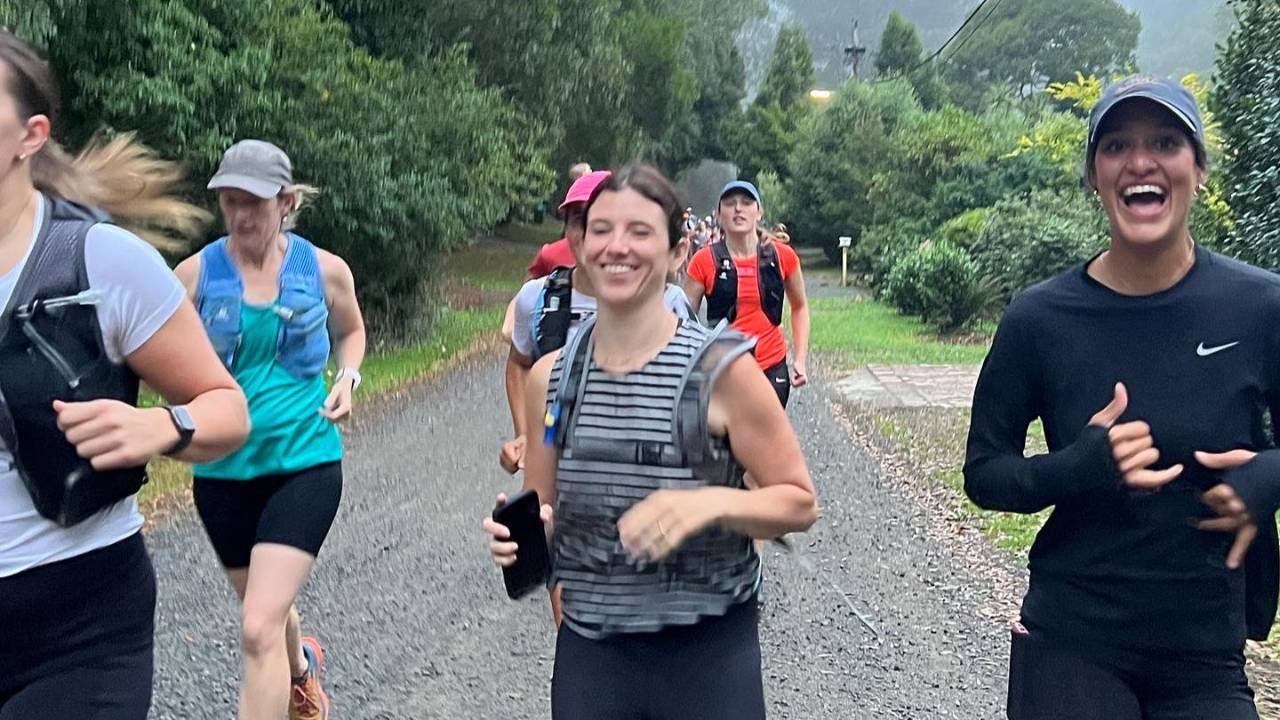
Fuelling During a Group Run
Trail Notes | Fuelling
from the 1-hour to the extended long trail morning
Fuelling During
a group run.
Some Her Trails group runs are close to an hour, and there Others keep moving for well over two. Your fuelling plan should change with the time, terrain and conditions.
A 60-minute social run after a normal meal rarely needs the same preparation as a long trail morning. Once the run moves beyond 90 minutes, or includes sustained climbing, heat or a harder effort, carrying and using carbohydrate becomes increasingly useful. The relaxed group pace can be deceptive: conversation-friendly on the flat, then demanding on the climbs.
Across Her Trails locations, the common mistake is treating every group run the same. Some women bring a full race vest for an easy hour. Others arrive at a two-hour-plus trail run with no food and one small flask. The better question is simple: how long will we be out, how demanding is the route, and what will the conditions ask of me?
This Trail Note gives you a practical plan for Her Trails group runs from around 60 minutes to more than two hours. It is not a compulsory eating or drinking schedule. It is a framework you can adjust to your body, the route and what you have already eaten.
The duration decides the starting plan. The terrain, effort and weather help you refine it.
An easy 60-minute run may need no fuel during it. A run approaching 90 minutes may need a snack in your vest. Beyond two hours, fuelling should be planned, carried and practised.
Trail Note · 01
Why the group run is an awkward fuelling zone
Most recreational runners have two default fuelling modes: the short run where they carry nothing and the race where they have a detailed plan. Her Trails group runs cover the space between them. The one-hour run and the two-hour-plus run should not use the same plan, even when both feel social.
There is also a social layer. Stopping to eat when nobody else has stopped can feel conspicuous, particularly early in a run. There is a tendency to wait until the "right moment", which often never comes, or comes too late to prevent a significant energy dip. We have heard many women in our community say they ate nothing on a 3-hour run because they did not want to slow the group down. This is a cultural problem as much as a nutritional one, and we address it directly later in this note.
Pace variability is another factor. A Her Trails group run is typically conversational in pace, but trail running is not consistent effort. A flat section at 6 to 7 minutes per kilometre becomes a hiking section up a technical climb, and the total energy expenditure of a two-hour trail run can rival a tempo effort of the same duration, simply because of the terrain, the pack carrying, and the muscle recruitment of climbing and descending.
Trail Note · 02
What changes as the run gets longer
Your muscles and liver store carbohydrate as glycogen, but there is no single minute at which every runner suddenly runs out. Starting nutrition, effort, fitness, terrain and individual physiology all affect how long those stores support the work. The useful distinction is practical: the longer or harder the run, the more benefit there is in supplying carbohydrate before energy and concentration begin to fall.
For an easy run of about 60 minutes, a normal meal pattern is usually enough. From 60 to 90 minutes, carry something if you started lightly fuelled, expect harder terrain or simply want to practise. From 90 minutes to two hours, plan at least one or two familiar carbohydrate opportunities. Beyond two hours, begin early and continue regularly rather than waiting until you feel depleted.
The same framework applies across menstrual phases and life stages. Some women notice changes in appetite, comfort or perceived effort across their cycle or through perimenopause, but current evidence does not support a separate universal carbohydrate target by cycle phase. Use your repeated experience to personalise the plan rather than relying on a calendar rule.
For the longer run, fuel before you need rescuing. The aim is steady energy, not catching up after the fade begins.
Trail Note · 03
What to bring: format, quantity, electrolytes
The best fuelling format for a group run is accessible, portable, easy to eat while moving, and something your gut has already tested. In a group run context, you want to be able to reach into your vest pocket at a walking break or a track junction and eat in 30 seconds without stopping the whole group. This rules out anything that requires preparation, a spoon, or a refrigerator.
For runs beyond about 90 minutes, 30 to 60 grams of carbohydrate per hour is a useful starting range for many recreational trail runners. Start toward the lower end if you are new to eating while running, then build through practice if the duration, effort or race goal requires more. In practical terms, one gel often provides around 20 to 25 grams, a banana around 25 grams, and a serve of chews around 20 to 30 grams. Check the label rather than assuming every serving is the same.
Electrolytes can contribute sodium, carbohydrate and flavour, and may be useful on longer or hotter runs or for runners with high sweat and sodium losses. They are not automatically required at a set time, they do not reliably prevent cramp, and they do not make excessive drinking safe. Consider them alongside the amount you are drinking, the conditions, the duration and what you tolerate.
Fuelling formats that work on a group run
Gels, quick, compact, easy to eat on the go. Choose one you have tested before.
Sports chews or bloks, chewable, slower to release, good for sensitive guts.
Medjool dates or dried mango, real food option with natural sugars and easy portability.
Banana halves in zip-lock bags, trusted, reliable, brings enough to share.
Rice balls or savoury bites, excellent for long runs above 3 hours.
Electrolyte tabs in a soft flask, low fuss, carries easily alongside food.
Trail Note · 04
When to eat relative to effort
Timing your fuelling on a trail run requires a little more awareness than fuelling on a road run because trail running effort is not constant. On a road run, you might set a timer for every 30 minutes. On a trail run, you need to read the terrain alongside the clock.
The most practical timing approach is to fuel before the hard sections rather than during them. Approaching a significant climb is a natural place to eat, you may be slowing to a hike, the group often bunches up, and your gut can handle the slight discomfort of a walking pace. Eating on a technical descent or at a running pace is harder on digestion and higher in aspiration risk. Junctions, saddles, flat trail sections, and any place the group naturally slows are your fuelling windows.
On a run of about an hour, you may not need to eat during the run at all. When you expect to be out beyond 90 minutes, take the first fuel early enough that it supports the second half—often around 45 to 60 minutes—then continue at a rhythm you have practised. Use safe, easier terrain or a walking section rather than trying to eat on a technical descent.
Match the plan to the expected run time
Around 60 minutes: arrive normally fed. Food during the run is usually optional; carry a small backup if the route is remote or the finish time may stretch.
60 to 90 minutes: a pre-run meal or snack may be enough. Carry one familiar fuel if you started lightly fed, expect harder effort or want to practise.
90 minutes to 2 hours: plan one or two carbohydrate opportunities, with the first commonly around 45 to 60 minutes.
More than 2 hours: begin early and continue regularly, using approximately 30 to 60 grams of carbohydrate per hour as a starting range.
After a longer run, eat a normal meal or snack containing carbohydrate and protein. Earlier recovery food matters most when your next training session is soon.
Trail Note · 05
The social side of eating on a run
Eating on a run in a group context can feel awkward. Particularly if you are new, or if nobody around you seems to be eating. There is a subtle social pressure to match whatever the group appears to be doing, and if the faster women at the front of the group are running without food, it can feel like eating is somehow less elite or less experienced.
Let us be clear about this in the Her Trails community: eating on a run is not a sign of weakness. It is a sign of experience. The women who have been trail running for years are almost always carrying more food than the women who are new to long distances, because they have learned the hard way what happens when you do not. If you pull out a gel or a bag of dates, you are more likely to prompt someone else to do the same than to attract any judgement.
Bring enough to share. This is one of the nicest things about our group run culture, and it matters. A spare banana, an extra gel, a little bag of lollies to pass around at the top of the climb, this is how fuelling culture gets normalised in a group. When experienced runners share food openly, it sends a message to every woman in the group that eating on the run is expected, normal and entirely welcome.
Her Trails coaching cue
Pack for yourself and one extra. The woman behind you who did not bring anything is not less committed to fuelling well, she just has not been coached yet. This is how you coach her.
Trail Note · 06
Pre-run fuelling: the meal that sets up the whole run
What you eat before the group run shapes how your fuelling strategy needs to work during it. A woman who ate a full, carbohydrate-rich breakfast two to three hours before the run starts with relatively topped-up glycogen stores and can afford to take the first fuelling hit a little later. A woman who arrived fasted, or who had a coffee and nothing else, needs to start fuelling earlier and more consistently.
For a run of about an hour, your usual meal pattern may be all you need. Before a run approaching or exceeding two hours, a familiar carbohydrate-led meal two to three hours beforehand is more useful. Oats with banana, toast with eggs, or rice with a familiar topping can work well. If the start is early and a meal is unrealistic, choose a smaller, easy-to-digest carbohydrate snack 30 to 60 minutes before.
Many women skip pre-run breakfast for Sunday group runs because they do not feel hungry on Sunday morning or because they are in a rush to get out the door. If this is you, keep a pre-portioned snack bag in your running kit that you can eat in the car on the way. Something is almost always better than nothing for a long group run.
Trail Note · 07
Hydration: match what you carry to the run
Fluid needs vary widely with body size, pace, temperature, humidity, clothing and individual sweat rate. A single 500 mL flask may be adequate for some cool, shorter runs but clearly insufficient for a long, exposed summer route. Check the expected duration, weather, water access and remoteness before deciding what to carry.
For a longer run, plan enough carrying capacity or reliable refill points so thirst can be met without rationing. Do not depend on untreated creek water unless the run plan specifically includes a safe treatment method. In hot conditions, shorten or relocate the run when the group cannot carry or access enough fluid safely.
Drink in response to thirst rather than forcing fluid to meet a universal hourly quota. In cold weather, at altitude or when conversation makes it easy to forget, use regular check-ins as reminders to notice thirst and how you feel—not as instructions to drink regardless. Avoid drinking enough to gain body mass during the run.
Cooler months (May-Sept)
Thirst may be less noticeable. Carry for the planned duration and check in regularly so you do not simply forget to drink.
Warmer months (Oct-April)
Expect thirst and sweat losses to increase. Carry more or plan reliable refills; consider an electrolyte drink if it supports your longer-run plan and is well tolerated.
Trail Note · 08
When a longer run starts to unravel
Underfuelling can contribute to a gradual loss of pace, concentration, mood and leg power during a longer run. It is more likely when you began with little food, delayed eating, increased the effort or stayed out much longer than planned.
If you are otherwise well and recognise the familiar signs of low energy, slow to a safe effort and take a small amount of familiar carbohydrate. Give it time and reassess. Do not try to eat while moving quickly over technical terrain.
Nausea, headache, dizziness, confusion, unusual behaviour, repeated vomiting, marked swelling, breathlessness or collapse should not be labelled as simple underfuelling. Stop and seek appropriate assistance; dehydration, heat illness, hyponatraemia and other medical problems can overlap.
A hard day on the trails is information.
Review the duration, effort, weather, food, fluid, recovery and how you felt. Fuelling may be part of the answer, but it should not automatically be treated as the only explanation.
Trail Note · 09
Gut training: why some foods work and others don't
Not every food that works in everyday life works during running. The gastrointestinal system is under measurable stress during exercise, blood is redirected from the gut to the working muscles, gut motility changes, and the absorption capacity of the intestinal wall is reduced. This is why foods that your body handles easily at rest can cause nausea, cramping, or urgent bathroom visits during a hard or long run.
The good news is that gut tolerance is trainable. The intestine adapts to absorbing carbohydrate during exercise when you practise it regularly. Women who never eat during training will often find their gut complains when they first try gels or food on the run. Women who practise fuelling consistently across their training runs find their gut becomes reliable and comfortable with the same fuels over time.
This means the group run is not the place to trial a new gel brand, a new electrolyte powder, or a new real food fuel for the first time. Test new fuels on solo training runs at low stakes. Bring your trusted, tested options to the group run. And if you are new to fuelling during exercise at all, start with something gentle, a banana, a small amount of dates, a plain carbohydrate gel, before moving to anything more complex.
Trail Note · 10
The post-run recovery window
After an easy one-hour run, your next normal meal may cover recovery perfectly well. After a longer or harder run, eating sooner becomes more useful—especially if you are training again within the next day. There is no 30-minute cliff after which recovery is lost.
Choose a meal or snack with carbohydrate and a useful serve of protein. Greek yoghurt with fruit and oats, eggs on toast, a smoothie with milk and banana, or a proper meal at home can all work. Coffee is fine; after a longer run, let it accompany food rather than replace it.
Many Her Trails groups have a post-run café or picnic tradition. It is an easy opportunity to eat, rehydrate according to thirst and connect with the women you ran alongside. Stay if you can; if you cannot, have a simple recovery option ready for the trip home.
Her Trails coaching cue
The café stop is not compulsory sports nutrition. It is simply a good chance to refuel, reconnect and begin recovering well.
Trail Note · 11
Fuelling for women: a few things worth knowing
Women have historically been under-represented in sports nutrition research, but that does not justify a separate universal fuelling formula. Duration, intensity, body size, training status, gastrointestinal tolerance and starting nutrition usually matter more than sex alone when planning one group run.
Your menstrual cycle may affect appetite, symptoms or perceived effort, but the evidence does not support routinely changing carbohydrate intake from one phase to another. If you notice a repeatable pattern, adjust practically—bring a more substantial pre-run snack, choose gentler foods or begin eating earlier—and assess whether it helps.
Across all life stages, the bigger concern is repeatedly starting longer runs underfuelled or finishing them without replacing enough energy across the day. If performance, recovery, mood, menstrual function or health is changing, look at the whole training and nutrition picture rather than assuming age or hormones are the sole cause.
Female-informed means asking better questions—not prescribing a different rule simply because you are a woman.
Trail Note · 12
Your group run fuelling checklist
Before every Her Trails group run, run through this mental checklist. It takes 30 seconds and it will change the quality of your run more reliably than any gear upgrade.
Before you leave home
Did I eat a real meal 2-3 hours before, or a small snack in the last 45 minutes?
Have I had normal access to food and fluid today, without trying to pre-load excessive water?
Do I have enough food in my vest for the expected run time, plus a spare for someone else?
What's in the vest
About 60 minutes: a backup snack if remote. Beyond 90 minutes: enough familiar carbohydrate to begin early and continue regularly.
Enough fluid-carrying capacity—or confirmed safe refills—for the duration, conditions and location.
Electrolytes only where they suit the longer-run plan, heat, sweat losses and personal tolerance—not as cramp insurance.
On the run
On runs beyond 90 minutes, take the first fuel before the second-half fade—often around 45-60 minutes.
Eat before climbs or technical sections, not during them.
Drink according to thirst. In cold weather or when distracted, use check-ins so you do not forget to notice it.
Trail Note · 13
Fuelling is a skill. Practise it like one.
A 60-minute group run can be a chance to build consistency without turning every session into a nutrition exercise. Longer group runs are where you can practise the race skills: opening food on the move, eating before hard terrain, carrying different formats and noticing what your gut tolerates.
If you are new to fuelling during runs, start on a session that will last beyond 90 minutes. Bring one familiar carbohydrate option, take it around 45 to 60 minutes, and notice how the second half feels. From there, build the plan gradually as the duration increases.
Fuelling well on the group run is not a complicated performance strategy. It is one of the simplest, most accessible things you can do to make every run feel better. And in a community that runs together, it is also one of the kindest things you can model for the women around you.
match the plan to the run
Written by the Her Trails coaching team
Trail Notes are evidence-informed coaching journals written for women who train, race and run on trails. Made to be absorbed in ten minutes and remembered for a season.
Keep going with us