
How to Start Trail Running: A Beginner's Guide
Trail Notes | Beginner Trail & Ultra Running
the trail will teach you the rest
A Beginner’s Guide
to Trail Running
You do not need to be fast, fearless or experienced to become a trail runner.
You may have been looking at the trails for a while, wondering whether you are fit enough, whether you need different shoes or whether everyone else will know what they are doing.
The barrier to starting is much lower than it appears. You need a suitable route, a few basic safety habits and permission to move more slowly than you might expect.
This guide will help you choose your first trail, manage the terrain, understand effort and arrive home wanting to do it again.
Trail running is not about taking your road pace into the bush.
It is about adapting to the ground, responding to the landscape and measuring the run by effort rather than speed.
Trail Note · 01
What makes trail running different
On a road, the surface and gradient are often relatively predictable. On a trail, the ground can change every few metres. You might move from smooth gravel to rocks, roots, mud, steps or a steep climb within the same kilometre.
Your stride changes with the terrain. Your ankles and hips make constant adjustments. Your attention moves between your footing, the route and what is happening around you.
This usually makes trail running slower than road running, even when the effort feels the same. A kilometre on a smooth path is not the same task as a kilometre with climbing, loose rock and technical descents.
Your road pace is not the standard you need to meet. The terrain sets the pace now.
If your trail pace looks slower, it does not mean your fitness disappeared. It means the task changed.
Trail Note · 02
Choose the right first trail
Your first experience does not need to be remote, steep or highly technical. Begin with a route that lets you learn without asking you to manage too many new things at once.
Look for a route that is
Clearly marked and easy to follow.
Popular enough that you are unlikely to be completely alone.
Close enough to roads, facilities or an easy exit point.
Mostly smooth, with modest climbing and limited technical terrain.
Short enough that you have time and energy in reserve if it takes longer than expected.
A loop can be enjoyable, but a short out-and-back route is often easier for a beginner. You can turn around whenever you reach half your available time or feel you have done enough.
Check the official park information, route difficulty, weather, daylight, fire conditions and track closures before leaving.
Trail Note · 03
What you actually need
You do not need to buy a full trail-running kit before your first outing. What you carry should match the route, weather, remoteness and expected time outside.
Shoes
Road shoes can be adequate on a short, smooth and dry path. Trail shoes become more valuable when the surface is loose, wet, muddy, steep or uneven. Prioritise comfort, fit and suitable grip rather than choosing the most technical shoe available.
Water and food
Carry water according to the conditions and route. For a short run after eating normally, you may not need food during the session, but carrying a small snack provides useful insurance if the run takes longer than planned. Once your runs pass 60 minutes, start fuelling in the first 30 to 45 minutes, building gradually towards about 60 g of carbohydrate per hour for long efforts, starting at 40 to 50 g if fuelling is new to you.
Navigation
Know the route before you begin and download the map for offline use. A phone is helpful, but it should not be your only plan on a remote route. Mobile reception can disappear quickly in trail environments.
Weather and safety
Carry a charged phone, sun protection and any layer the forecast requires. As routes become longer or more remote, add a first aid kit, headlamp, emergency layer and appropriate emergency communication such as a personal locator beacon.
Trail Note · 04
Your first trail run
Your first run will probably feel more demanding than expected, even at a slower pace. Your body is responding to the surface, changes in gradient and unfamiliar movement patterns.
Start with a short session and finish while you still feel capable. 20 to 40 minutes on a gentle route can teach you more than doing too much on a long first outing.
A simple first-run plan
Walk the first 5 minutes and settle into the surroundings.
Run at Base Run effort on smooth and comfortable sections.
Walk climbs, technical ground or anything that makes you tense.
Turn around at halfway based on time, not distance.
Finish with enough energy that you could have continued for another 10 minutes.
Trail Note · 05
Run by effort, not pace
Pace can still be interesting data, but it is not the most useful guide when gradient and terrain are constantly changing. Use your breathing and ability to speak to judge effort.
The conversation test
Base Run effort: You can speak comfortably in full sentences.
Moderate: You can speak in shorter sentences, but conversation takes more effort.
Hard: You can manage only a few words at a time.
Most of your early trail running should be at Base Run effort, where you can hold a conversation. If a climb pushes you beyond that effort, walk it.
Power hiking is part of trail running at every level. It helps manage effort, protects energy and often moves you up a steep climb just as effectively as forcing a run.
Walking is not what happens when trail running goes wrong. Walking is part of how trail running works.
Trail Note · 06
Learn to read the ground
Trail confidence comes from learning to look ahead, notice what the ground is doing and adjust before you reach it.
Terrain basics
Scan a few steps ahead rather than staring directly at your feet.
Use shorter, quicker steps when the ground becomes uneven.
Keep your arms available for balance rather than holding them tightly by your sides.
Slow down before technical sections instead of trying to brake once you are already on them.
Treat wet roots, rocks, leaves and timber with extra caution.
Walk any section that feels beyond your current confidence or skill.
Do not rush this skill. Confidence grows through repeated exposure to manageable terrain, not by forcing speed on ground you do not yet trust.
Trail Note · 07
Build gradually
You do not need a formula that converts road kilometres into trail kilometres. Routes vary too much for one percentage to work reliably.
Instead, begin with less time and less technical terrain than you think you could manage. Notice how your calves, ankles, hips and feet respond later that day and the following morning.
Start with one trail session each week. Repeat familiar routes and increase only one challenge at a time. That challenge might be time, climbing, technical terrain or speed.
You can continue road running while learning the trails. Familiar surfaces can support consistent training while your trail-specific strength and confidence develop.
Her Trails coaching cue
Repeat a beginner-friendly route several times. Familiarity lets you notice your technique, effort and confidence instead of spending the whole run wondering where to go.
Trail Note · 08
Make safety part of the routine
Trail environments can be natural, remote and unpredictable. A few consistent habits make it much easier to explore them safely.
Before every trail run
Check the official weather forecast, park alerts, fire conditions and track closures.
Tell someone your route, start time and expected return time.
Download your route and map before leaving mobile reception.
Carry enough water, food, clothing and daylight for the actual route and conditions.
Stay on the planned route and turn around if conditions change.
For remote areas without reliable phone reception, carry an appropriate emergency communication device.
Starting with a group on a familiar route is one of the easiest ways to learn these habits while building confidence.
Trail Note · 09
Understand basic trail etiquette
Good trail etiquette is mostly about awareness, communication and leaving space for other people and the environment.
Stay on marked trails and take all rubbish home.
Move to the side safely when allowing someone to pass.
Give a friendly warning before passing from behind.
Make room for walkers, runners and other permitted trail users.
Follow local rules about dogs, bikes and shared trails.
Avoid widening the track to move around mud. Moving through the centre helps protect vegetation beside the trail.
Trail Note · 10
Let community shorten the learning curve
Running with people who know the local trails gives you access to knowledge that is difficult to collect from a map.
You learn which sections become slippery after rain, when to walk a climb, how to position yourself on a descent, what people carry and how experienced runners respond when plans need to change.
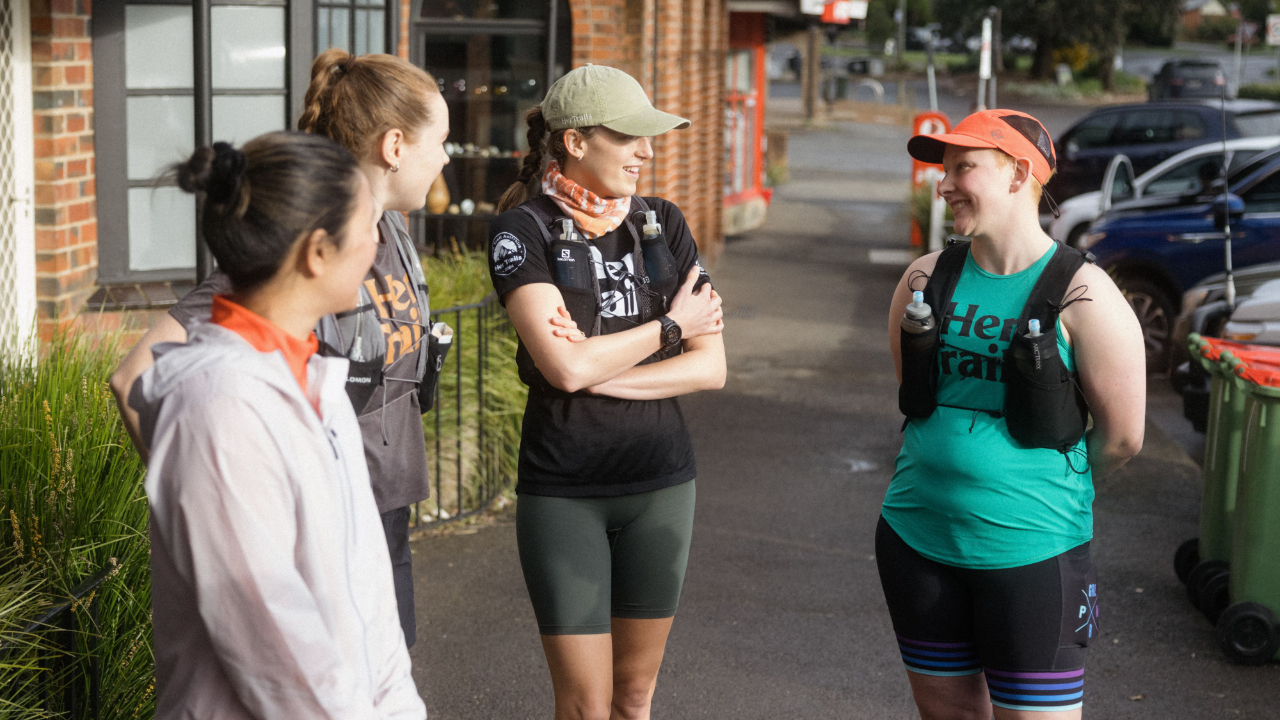
A supportive group also changes what it feels like to be new. You do not need to arrive with all the answers. You can learn by moving alongside people who remember what beginning felt like.
You do not need to know what you are doing before you join us. Helping you learn is part of why the group is there.
Start with the trail in front of you
Trail running can eventually lead to long mountain days, remote landscapes and finish lines you cannot yet imagine. None of that needs to be decided now.
Your first job is smaller. Choose a manageable trail. Check the conditions. Tell someone where you are going. Move at an effort you can sustain. Walk whenever the terrain asks you to.
Then come back and do it again. Confidence is built one familiar turn, one walked climb and one careful descent at a time.
The trail does not ask you to prove that you belong there.
Slow down. Look ahead. Stay curious. That is enough for the beginning.
the trail will teach you the rest
Written by the Her Trails coaching team
Trail Notes are practical, evidence-informed guides for women who want to move, train and explore with greater confidence.
Safety guidance
Review the official visitor information for the park you are entering. For broader Australian bush safety guidance, see Think Before You TREK and your state or territory parks authority.
Take your first trail step with us