
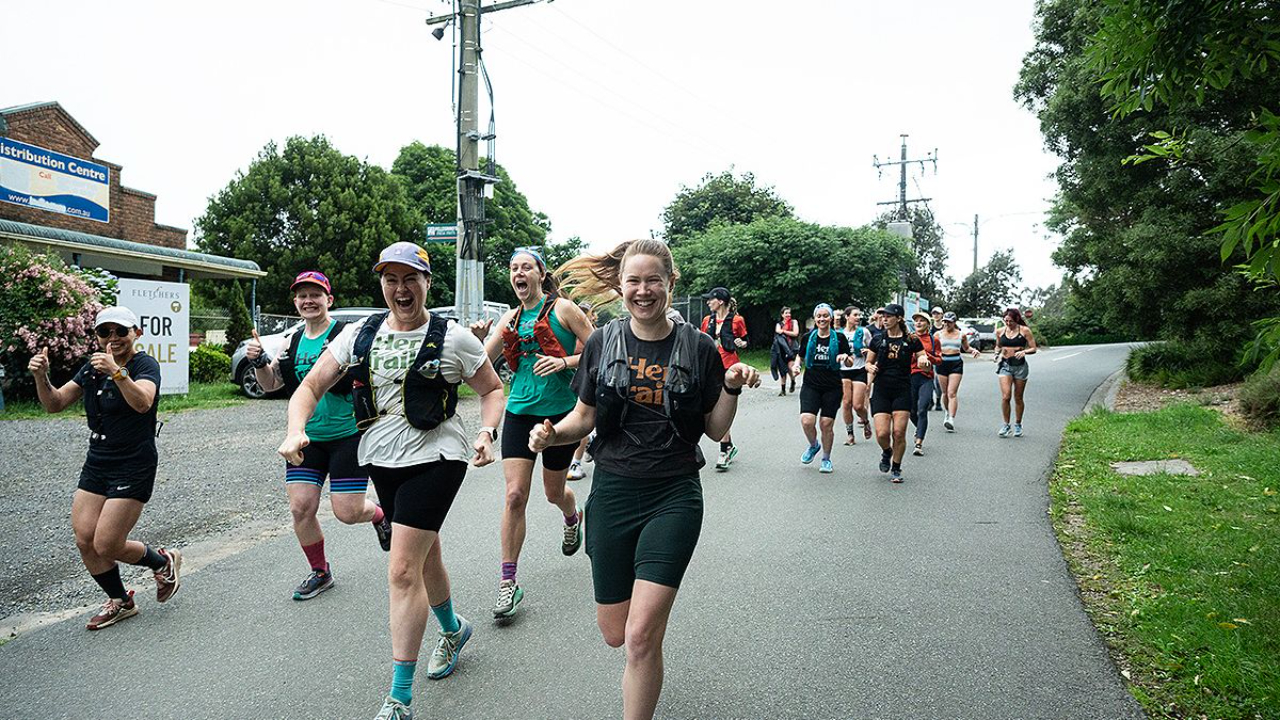
42.2 kilometres, built for her
Trail Notes | Female Athlete Racing
42.2 kilometres, built for her
The Road
Marathon.
The road marathon asks you to hold a hard, honest effort for hours on unforgiving ground.
Trained for with respect for your physiology, it is also one of the most rewarding builds in endurance sport, and a brilliant doorway to the trails. For many of us the 42.2 is the first truly structured endurance build we take on, and often the stepping stone toward longer trail and ultra events. It is the most demanding road distance, asking you to sit close to your aerobic threshold for 3 to 6 hours or more.
This note walks through how the Her Trails 16 week road marathon program is built, how it differs from trail training, and where your physiology as a female athlete changes the plan.
The marathon does not reward the athlete who trains hardest. It rewards the one who builds patiently and paces with discipline.
Both are strengths many female endurance athletes bring.
Trail Note · 01
The 16 week shape
The program moves through 4 phases, each with a clear job. Nothing is random, and the early weeks earn the right to the later ones.
Weeks 1 to 4 · Base
Aerobic foundations. Mostly easy Zone 2 running, gradual volume, one quality session a week, long run growing from around 16km to 22km. The goal is consistency and finding any injury vulnerability before the load climbs.
Weeks 5 to 10 · Build
Race-specific work arrives. Two quality sessions a week, one threshold or interval, one long run with race-pace elements, long run building toward about 28 to 31km. Load rises deliberately, with planned recovery weeks so adaptation consolidates rather than piling into fatigue.
Weeks 11 to 14 · Peak
The hardest block. Long runs reach their maximum of about 31km, intensity is highest, volume peaks. This is where the fitness is won, and where sleep, nutrition and recovery matter most. Expect to feel tired here, and pay attention to how well you recover.
Weeks 15 to 16 · Taper
Volume drops sharply while a little intensity stays, so the legs freshen without going flat. The focus shifts to logistics, fuelling rehearsal and race-day headspace.
Trail Note · 02
Why road is not just trail on tarmac
The training philosophy is the same as our trail programs, a strong aerobic base, female-specific awareness, progressive overload with real recovery. But the road changes the demands in three ways worth understanding.
Surface
Road is the same repetitive contact, over and over, with little variation. That builds pace efficiently but repeats the same stress on the shin and foot, where soft, varied trail ground spreads the load more. Coming from trails, treat the surface change as a new stimulus and build conservatively for the first 4 to 6 weeks.
Intensity
Marathon race pace sits close to threshold, notably higher than the sustainable effort of most ultras, where you spend the day in Zone 2 to 3. So road training carries a higher dose of threshold and pace-specific work, without ever abandoning the easy aerobic base that underpins it all.
Recovery demand
A 28 to 31km road long run at marathon-adjacent effort can be a bigger muscular hit than a longer ultra run at easy Zone 2 with hiking. The constant eccentric loading of flat ground adds up. Respect the 48 to 72 hours after your longest runs as much as you would after a huge day on the trails.
Trail Note · 03
Where your physiology can be an advantage
Two features of female physiology and racing behaviour may help in the marathon, and both are worth leaning into rather than apologising for. Individual variation is large, so treat them as possibilities, not promises.
The first is fuel use. Research suggests that sex hormones influence how the body uses fat and carbohydrate, and with a solid Zone 2 base many female athletes hold marathon pace on a good mix of both. That matters most in the second half, as glycogen runs low. The classic wall around 32 to 36km can be less brutal when the first half was paced with restraint and fuelling started early.
The second is pacing. In our coaching experience, many female athletes pace marathons more evenly, and even pacing is generally associated with a stronger finish. The conservative first half is not timidity. It is strategy, and it is one we should name and reinforce out loud.
A patient first half is not holding back. In the marathon, it is one of the best ways to run a strong finish.
Trail Note · 04
Heat and pelvic floor
A few female-specific factors deserve a place in your plan rather than a surprise on the day. Heat is the big one on a warm road course, on dark asphalt with little shade. Start conservatively on temperature, use cooling early, and judge effort by feel rather than chasing an absolute pace. Some women notice patterns across the month, and others notice little difference. Track your own pattern, and remember that we train the person, not the phase.
Pelvic floor is the other one we should talk about openly. The repetitive, higher-cadence impact of road running loads the pelvic floor differently from trail running, where varied effort and walking give natural breaks. If you have any leaking, heaviness or prolapse symptoms during or after long runs, see a pelvic health physiotherapist before taking on a full 16 week build. This is normal, common, and very treatable, and it is far better addressed early.
Her Trails coaching cue
When a key session feels harder than the numbers say it should, whether from heat, sleep, a heavy week or something else, switch your target from pace to perceived effort, and treat the result as completely valid. You trained your system, regardless of what the watch said.
Trail Note · 05
The sessions that matter most
A handful of key sessions carry most of the race-specific adaptation. Get these right and the rest supports them.
Marathon-pace long run
A 28 to 31km run with the final 10 to 16km at goal pace. The most race-specific session you do. Rehearse fuel, shoes, timing and conditions exactly as race day.
Threshold intervals
Reps of roughly 8 to 12 minutes at marathon to threshold effort. Build the lactate-clearing capacity race pace demands. Target by perceived effort, not a fixed pace.
Progression runs
Medium runs that start easy and finish at marathon pace. Train the fuel switch from fat to carbohydrate, and the habit of running faster as you tire.
Easy aerobic running
The quiet foundation under everything. Easy Zone 2 volume builds the engine that makes the hard sessions possible. Do not race your easy days.
Trail Note · 06
From marathon to the trails
A well-executed marathon build is a superb launchpad for ultra running. The aerobic base, the fuelling practice, the mental skills, the pacing discipline and the lived experience of sustained high-load training all transfer directly.
What you add for the trails is elevation-specific fitness, more low-intensity volume at ultra pacing, and the shift from the marathon's relentless even effort to the ultra's variable effort with intentional walking. If you are eyeing a 50km after your road marathon, give yourself a 4 to 6 week recovery and transition block before starting a new 20 week trail build. You will arrive fresher and stronger for it.
The marathon teaches patience, fuelling and honest pacing. The trails are where you get to spend everything it taught you.
Build the base. Respect the surface. Pace with discipline. Honour your physiology. The next good decision.
run the marathon your body is built for
Written by the Her Trails coaching team
Trail Notes are evidence-informed coaching journals written for women who train, race and run on trails.
Reflects the Her Trails 16 week road marathon program structure and female endurance physiology. Endurance and sex differences: Le Mat et al., 2023 (PMID 36802328). Pelvic floor: de Mendonca et al., 2023 (PMID 37107817), a small pilot study. Female athlete nutrition: Sims et al., ISSN position stand, 2023 (PMID 37221858). This note is general coaching education, not individual medical advice.
Keep going with us