
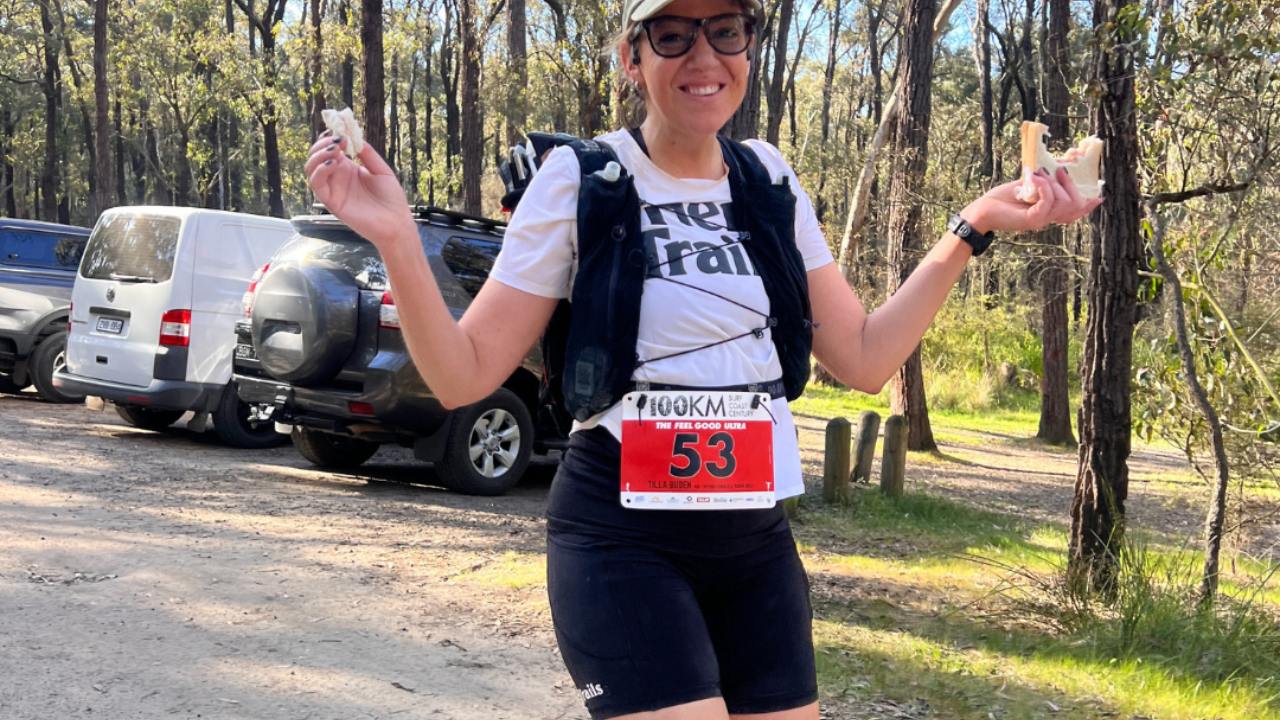
Stepping Up to the 100km.
Trail Notes | Female Athlete Racing
8 to 16 hours of patience
Stepping Up
to the 100km.
Many of us who struggle at 100km do not run out of fitness. We run out of gut, or we run out of patience in the first 3 hours.
The 100km, roughly 8 to 16 hours, is a major long-distance goal for many Australian trail runners. Surf Coast Century, the UTA 100, Tarawera and Kosci all live around here. It is the distance where ultrarunning becomes a different sport, and it needs a more flexible schedule, around 8 to 12 hours a week, and manageable life stress.
A Her Trails 100km program runs for 20 weeks. It is built to sharpen the trail and ultra base you already have, not to replace it. If you are newer to trail and ultra running, give yourself more time to build that base before you start, and talk to your coach about what is realistic for you.
Some of the adaptations needed to run 100km are slow to build, and they cannot be rushed.
You cannot rush them with bigger weeks. Trying does not accelerate the adaptation. It raises your injury risk.
Trail Note · 01
How the training is built
Weekly volume depends on your base and your life load. The long run is capped at roughly 75 percent of race distance and about 4 to 4.5 hours, and you start to include back-to-back long days, for example 28 kilometres on Saturday and 20 on Sunday, so you learn to run on tired legs. Where recovery allows, you can carry two quality sessions a week.
Two kinds of durability matter at 100km, and they build on different timelines.
Metabolic durability, holding your pace without cardiac drift and processing fuel efficiently across 8 hours, responds to training within months. You can see it improving inside a single training block. Musculoskeletal durability, the ability to maintain form and tissue integrity in the final 20 kilometres when every other system is begging you to collapse, is slower. Tendons, bone, and connective tissue remodel more slowly than fitness does, which is why consistent load builds them and volume spikes cannot shortcut them.
The back-to-back long days are in the program to build the second type. Not fitness. Resilience.
The non-negotiable at this distance
Gut training begins in earnest. Practise your race nutrition on every long run.
Start fuelling early in each session, within the first 30 to 45 minutes.
Use the foods and products you intend to race on, not whatever is convenient.
Trail Note · 02
Why the gut is the gatekeeper
8 to 16 hours introduces a fuelling demand that is poorly understood by many of us coming up to this distance. If you have never practised eating during exercise, this is where the day unravels, and it unravels through your stomach long before it unravels through your legs.
The fix is unglamorous and it works. Build gut training into your long runs from the earliest stages of preparation, so that by race day eating on the move is a trained skill rather than a hopeful experiment.
Your gut is trainable. Treat it like any other system you would not leave to chance on race day.
Gut training has a structure. It is not simply eating on your runs. It is deliberately progressive practice.
Start at your current comfortable intake, whatever that is, and build over several weeks toward about 60 grams of carbohydrate per hour for long efforts, never below 40 grams, and up to 90 grams only if your gut is trained for it. Vary the form. Gels work in training but real food becomes increasingly important as duration extends beyond 6 hours. What you can stomach at 3 hours is not what you can stomach at 10. The only way to know is to practise it, on tired legs, in the conditions you expect to race in.
Practise fuelling in a range of conditions: heat, cold, early morning and late in a long day. If you notice your gut feels different at different times of the month, make a note of it and use your own pattern.
Trail Note · 03
Pace the first third like it costs nothing
Pacing data from very long ultras found that sex did not consistently change pacing strategy. What it did show is that slower finishers tended to start proportionally faster than their eventual pace could sustain. The early enthusiasm is the trap, not the terrain.
So the cue is simple. The first third should feel too easy. Hold back harder than feels necessary for the first 3 to 4 hours. You can always build into the race later. You cannot recover from a first third run on adrenaline.
Whatever time of the month you race, hold back harder in the first third than you think necessary. Heat, fatigue and a long day can all make a familiar pace feel harder than your fitness suggests it should. The temptation is to force the pace. The smarter move is to trust effort over pace, run by feel not by watch, and build from hour 4 onward rather than hour 1.
Trail Note · 04
The tissue that training cannot rush
Some adaptations are slower than others, and the slowest ones protect you at 100km.
Cardiovascular fitness responds quickly, with measurable gains inside 6 to 12 weeks. Aerobic enzymes and mitochondrial density adapt across months. But tendons, ligaments, bone cortex, and the cartilage under your kneecap operate on a different clock entirely. They remodel slowly, responding to load but unable to accelerate on demand.
Women carry a specific consideration here. Oestrogen plays a role in bone health, and in the perimenopausal and postmenopausal years some women find their load tolerance changes. This does not mean stopping. It means respecting the timeline and paying close attention to how your own body responds.
Bone stress injuries are a serious risk for runners building toward longer distances, and they are often associated with a rapid rise in load: a big training block, a race too soon, a return from illness that moves faster than the bone can absorb. The soft tissue often gives you warning signals. Bone does not always.
The fix is not complicated. Build load gradually, and follow your program’s weekly progression rather than adding extra kilometres on top. Treat rest weeks as load weeks, not lost weeks, because they are when your body adapts. And respect the difference between aerobic readiness, which arrives sooner, and structural readiness, which takes longer.
Trail Note · 05
If you came to this later, you are not behind
If you came to ultra running in your thirties or later, as so many of us do, you are not past your best. Many women keep developing as ultra runners well into midlife and beyond.
Hold that thought when the timeline feels slow. The months of building are not time you are losing. It is time you are arriving exactly on schedule for the body you are growing into.
At 100km you do not earn the distance with one big block. You earn it with months of trained gut, conservative pacing and patient load.
Volume that builds slowly. Fuel practised on every long run. A first third that feels too easy. A timeline you respect.
arrive with evidence, not hope
Written by the Her Trails coaching team
Trail Notes are evidence-informed coaching journals written for women who train, race and run on trails. Made to be absorbed in 10 minutes and remembered for a season.
Informed by Bearden and van Woerden, Pacing and placing in 161-km ultramarathons: effects of sex and age (2025, PLoS One, PMID 40354403).
Keep going with us