
How to Start Trail Running: A Beginner's Guide
Trail Notes | Beginner
the trail will teach you the rest
How to Start
Trail Running.
You have been thinking about it. Maybe for a while. The trails look like freedom, like a different kind of running, like something your road kilometres have been building toward without you quite knowing it.
Good news: the barrier to starting trail running is much lower than most people assume. You do not need expensive gear, elite fitness or a technical skillset before you set foot on dirt. You need some basics, a bit of context about how trail running is different from road running, and the willingness to slow down and pay attention.
This Trail Note covers what you need to know to start well, stay safe, and build a trail running practice that keeps you coming back.
Trail running is not road running on dirt. It is a different discipline, and that difference is what makes it so good.
The terrain asks more of you. The pace asks less. The result is a kind of running that is harder on your legs and easier on your head than almost anything else you can do.
Trail Note · 01
How trails are different from roads
Road running rewards consistency of pace and cadence. Trail running rewards adaptability. The surface changes underfoot constantly. You climb, you descend, you pick your way through roots and rocks, you adjust your stride length automatically every few seconds. This is mentally engaging in a way that a flat, consistent road surface simply is not.
Trail running is also slower. Kilometre for kilometre, trail running takes more time and more energy than road running at equivalent perceived effort. A trail kilometre might take you significantly longer than a road kilometre, and that is not a reflection of fitness. It is terrain. Adjust your expectations accordingly from day one, and you will enjoy yourself far more.
The comparison that matters on trail is not pace. It is effort. More on that shortly.
Trail Note · 02
What you actually need to get started
The trail running gear industry would have you believe you need a lot. You do not. Here is what actually matters when you are starting out.
What matters from the start
Trail shoes with a grip sole. You do not need the most aggressive lugs on the market. You need a shoe that grips better than a road trainer on dirt and uneven ground. Visit a specialist running store and ask for help with fit.
A way to carry water. Even on short runs, bring more water than you think you need. A simple handheld bottle is fine to start. A small vest or pack comes later as your distances grow.
A navigation plan. Know where you are going before you leave. Use an app like Wikiloc, AllTrails or Strava with offline maps available for the area. Tell someone where you are going and when you expect to be back.
Sun protection, a light layer if conditions are variable, and a charged phone. These basics matter most on the trail.
Everything else, the vests, the poles, the GPS watches, the gaiters, comes with time and distance. Start simple. Add as you learn what you actually need.
Trail Note · 03
Your first trail run: what to expect
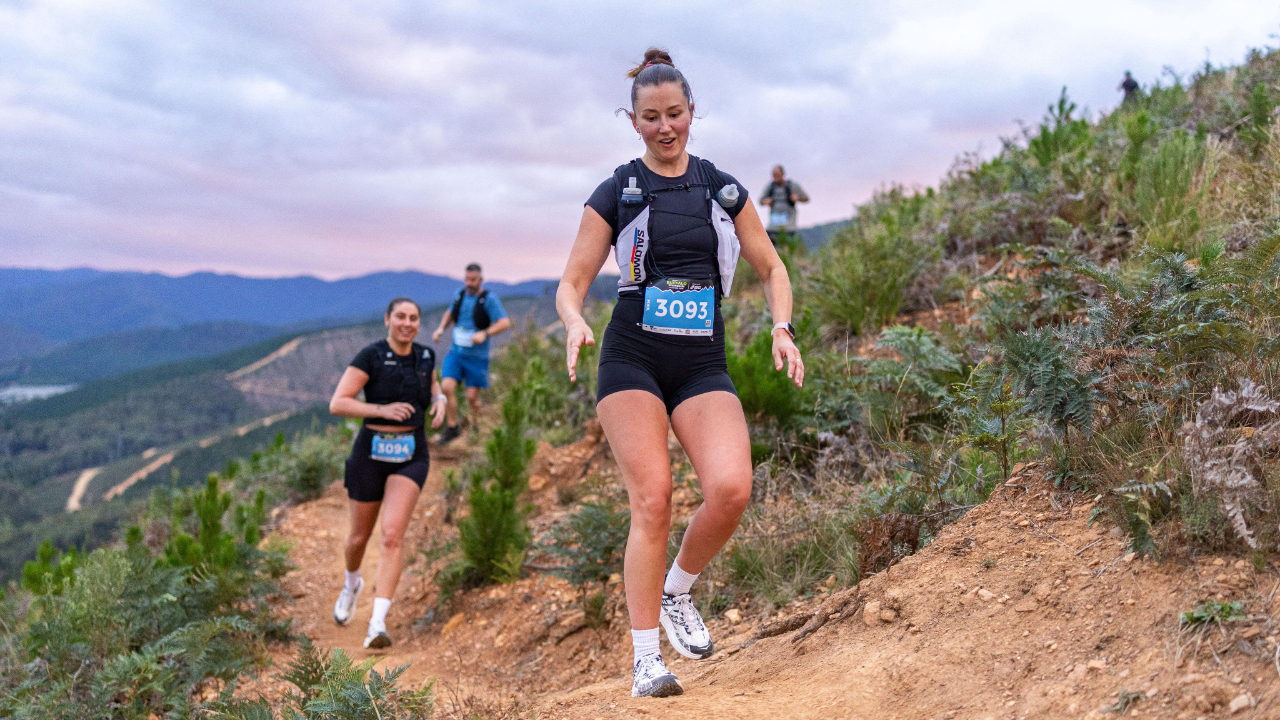
Your first trail run will probably feel harder than you expected at a pace that feels slower than you expected. Your legs will work differently. Your ankles will be doing constant micro-adjustments you are not used to. Your attention will be split between the ground beneath you, the path ahead, and the view around you. This is entirely normal, and it is part of why trail running is so absorbing.
Start shorter than you think you need to. A 20 to 30 minute trail run as a first outing is smart, not cautious. You are training new muscle groups, new movement patterns and new terrain awareness all at once. Your body is learning, even if your cardiovascular system feels untaxed.
Expect to walk sections. Expect to feel clumsy. Expect to love the view. These are all very normal features of a first trail outing.
Give yourself permission to be a beginner again. It does not last long, and it is actually quite wonderful.
Trail Note · 04
Run by effort, not by pace
This is possibly the most important skill to develop as a trail runner, and the sooner you embrace it, the more you will enjoy your running. Your GPS watch is not your coach on trail. Pace is irrelevant when the ground is doing something different every 10 metres.
Instead, use the conversation test. On an easy run, you should be able to speak in full sentences. On a moderate run, you can talk but not comfortably. On a hard run, you can say a few words. Most of your early trail running should sit comfortably in that first zone, where you could hold a conversation if someone were running alongside you.
This means walking climbs freely and without guilt. Power hiking a steep ascent is not a failure. It is good trail running strategy. The athletes who go out in front on climbs and blow up before the descent are not running smarter. They are just burning more matches early.
Her Trails coaching cue
Put your watch on time-only mode for your first few trail runs. Remove pace as a data point entirely. You are learning terrain, not testing fitness. The two do not belong in the same session.
Trail Note · 05
Reading terrain: the skill you build gradually
Terrain reading is the ability to look several metres ahead on the trail, process what the ground is about to do, and adjust your foot placement, speed and stride before you get there. It is a skill that develops with time and repetition, and it is what separates confident trail runners from anxious ones.
In the beginning, look down closer to your feet. As you gain confidence, your gaze will naturally lift further ahead. On descents, look where you want to go, not at the obstacle you want to avoid. Shorten your stride on rocky or rooted sections. Lean slightly forward on descents and engage your arms for balance. These habits build naturally with practice.
Terrain basics for beginners
Slow down on any surface you are unfamiliar with. Speed comes with trust, and trust comes with repetition.
Wet rocks, wet roots, wet wooden bridges and wet leaves are all significantly more slippery than they look. Treat them with respect.
Use your arms. They are your balance tools on uneven ground. Do not run with them pinned to your sides.
Land with a shorter stride on technical ground. Longer strides on smooth sections are fine. Adapt to what is beneath you.
If it looks dangerous, walk it. There is no prize for running a section that genuinely scares you. Confidence comes with time.
Trail Note · 06
How to build your trail base
If you are coming from road running with a solid base, you can start trail running immediately, but scale your distances back by about 30 to 40 percent initially. A 10 kilometre road run and a 10 kilometre trail run are not equivalent asks of your body. Your ankles, calves and hips are doing significantly more stabilising work on trail, even if your heart rate feels similar.
If you are newer to running in general, build a comfortable base on easier terrain (fire roads, flat park trails, well-groomed paths) before introducing technical single-track, significant climbs or long descents. Your cardiovascular system may be ready long before your ankles and connective tissue are.
Her Trails coaching cue
One trail run per week is enough to start building trail-specific strength and confidence. You do not need to abandon road running. The two complement each other beautifully, and many runners do both indefinitely.
Trail Note · 07
Safety and running solo
Running solo on trails is one of the great pleasures of the sport. It is also something to approach with a baseline of sensible preparation, especially in your early months and on routes you do not know well.
Solo safety habits
Tell someone your route, your start time and your expected return time. Even a text message to a friend counts.
Download offline maps before you go. Mobile data is unreliable in most trail environments.
Carry a fully charged phone. A small personal alarm is optional but worth having in more isolated areas.
Start on well-marked trails with regular foot traffic until you are comfortable with navigation.
Trust your instincts. If a section does not feel right, turn around. The trail will still be there next time.
Running with others, especially with an established community, is also one of the fastest ways to build trail skills and confidence. The experience in a group run is years of terrain knowledge, and it is yours to absorb just by showing up.
Trail Note · 08
Why community accelerates everything
One of the best things you can do as a new trail runner is run with people who know the trails and are willing to share what they know. Trail running communities are generally warm, inclusive and deeply happy to see new people discovering a sport they love.
In a single group run, you might learn: where the best grip lines are on a technical descent, which sections tend to be muddy after rain, what to do if you find yourself at the back of the group, how to fuel on the move, how to power hike efficiently, and that even experienced runners walk the big climbs. This kind of knowledge takes months to accumulate alone. In community, it arrives immediately.
Our Sunday group runs are specifically designed for runners of all experience levels. They are where many of our community members took their first trail steps, and where they keep coming back years later.
You do not need to know what you are doing before you come. You just need to show up. The trail will teach you the rest.
Trail Note · 09
What keeps trail runners coming back
Ask any trail runner why they started, and the answer is usually fitness or curiosity. Ask them why they kept going, and the answer is almost always something else. The feeling of being in nature. The way the brain quietens when you have to focus on the ground. The community. The sense of places earned through effort rather than driven to. The completely unpretentious relationship with pace and performance that trail running naturally produces.
Trail running has a way of making road runners wonder why they ever spent so much time on pavement. It also has a way of making complete beginners fall in love with running for the first time, because it removes the pressure of performance and replaces it with the pleasure of exploration.
The best trail to start on is the one you can get to this week. The best time to start is now. Everything else follows.
The trail does not care how fast you are. It cares that you showed up.
Slow down. Look up. Pay attention. That is the whole game at the beginning, and honestly, it remains the whole game forever. The terrain just gets more interesting as you go.
the trail will teach you the rest
Written by the Her Trails coaching team
Trail Notes are evidence-informed coaching journals written for women who train, race and run on trails. Made to be absorbed in ten minutes and remembered for a season.
Keep going with us