
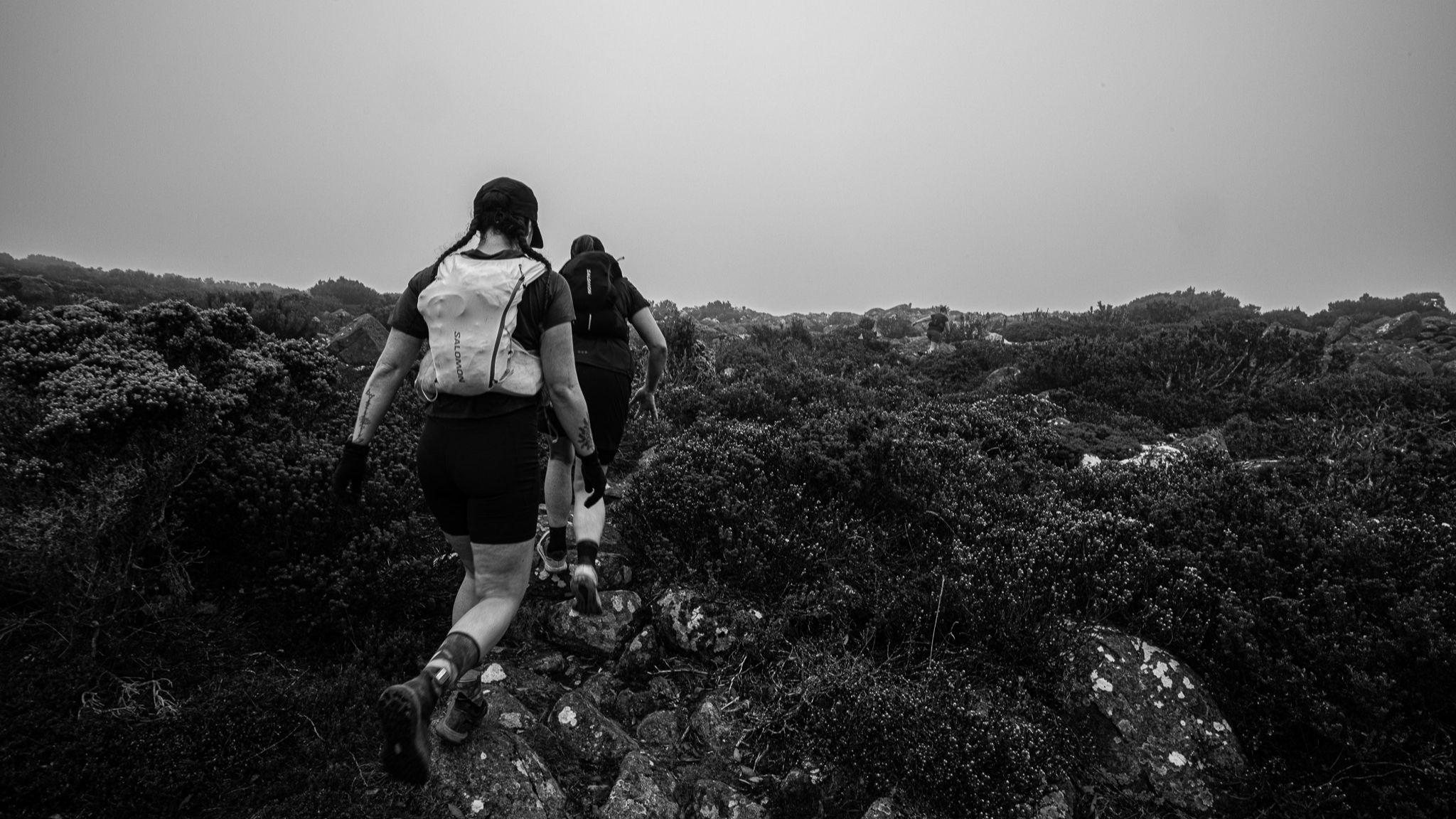
How to Climb Like a Trail Runner
Trail Notes | Trail Skills
find your rhythm, not your limit
How to Climb Like
a Trail Runner.
Climbing well is not about forcing your way uphill. It is about finding a rhythm you can hold long enough for the climb to become part of the run, not a battle inside it.
Trail climbing is its own skill. It is different from running uphill on the road, where the surface is usually predictable and the grade is often consistent. On trail, the climb may shift every few metres. You might move from smooth dirt to rocks, roots, stairs, sand, mud, grass, fire trail or singletrack.
The pitch can change quickly. The footing can demand attention. Your breathing can rise before your legs feel ready. This is why good climbing is not simply a fitness question. It is a rhythm question, a strength question, a decision-making question and a pacing question.
The runners who climb well are not always the ones who charge hardest.
They are the ones who hold rhythm, manage effort and arrive at the top with something still in reserve.
Trail Note · 01
Climbing changes the cost of movement
On flat ground, your effort and your pace usually move together. When you push a little harder, you go a little faster. The signals match. But a climb changes the cost of movement. Your heart rate rises. Your breathing changes. Your calves, glutes, hamstrings and hip flexors have to work differently.
If you fight that change, the climb will usually win. Trail climbing asks you to shift from pace-based thinking to effort-based thinking. You are not trying to keep the same speed. You are trying to keep the effort sustainable.
A strong climb is not always a fast climb. A strong climb is one you can recover from while still moving.
Trail Note · 02
Shorten your stride
The steeper the climb, the shorter your stride needs to become. Long strides uphill usually increase muscular cost. They ask more from the calves, glutes and hamstrings, and they can create a braking feeling with each step.
Shorter steps help you stay lighter, more balanced and more responsive to uneven ground. Think quick, quiet and compact. Your cadence may increase slightly, but your effort should stay controlled. You are looking for the rhythm that allows you to keep moving without overloading any single muscle group.
Her Trails coaching cue
Climb with short, light steps. Save your stride for the flat. Save your power for the moments that ask for it.
Trail Note · 03
Know when to hike
Strong trail runners hike. They hike with intention. They hike with posture. They hike with purpose. Hiking is not a failure of fitness. It is often the smartest pacing decision available on the climb.
If the trail is so steep that running drives your heart rate uncomfortably high, if your form is collapsing, or if continuing to run would cost you the next section, switch to a strong hike. A purposeful hike can be just as fast as a struggling run, and often more sustainable.
A strong hike looks like
Tall posture through the chest and head.
Hands resting on the thighs or quads for extra drive.
A purposeful press through each step, not a shuffle.
Eyes scanning ahead for the cleanest line.
Breathing that stays controlled enough to keep eating, drinking and thinking.
Trail Note · 04
Use your arms
Climbing is a full body movement. On the road, arm swing can feel like a small detail. On a steep trail, it becomes a source of momentum. A controlled, driving arm action helps you maintain rhythm, supports your breathing and reduces the load on your legs.
When you switch to hiking, your arms still have a job. Press through the thighs. Drive from the shoulders. Allow the upper body to support the lower body. The strongest climbers move as one piece, not as a pair of tired legs dragging a passive torso uphill.
Trail Note · 05
Read the climb in sections
Long climbs can feel overwhelming when you take them in as one giant effort. Strong trail runners break climbs into smaller sections, often without thinking about it consciously.
They might run to a particular tree, hike to a switchback, then run again. They might choose effort targets rather than distance targets. They might decide to run the flatter rolls and hike the steeper ramps, then reassess.
This keeps your mind engaged and your effort responsive. Good trail runners are constantly making small decisions. They do not wait until they are exhausted to adjust. They notice, respond and keep moving.
Do not climb the whole hill in your head. Climb the piece of trail you are on.
Trail Note · 06
Protect the top of the climb
One of the most common mistakes is treating the top of the climb as the finish line. In most trail runs and races, the top is not the end. It is a transition. If you arrive completely breathless with heavy legs and poor posture, the descent or flat section that follows becomes harder than it needs to be.
Try to crest the hill with enough control that you can resume running smoothly. This might mean backing off slightly in the final third of the climb. That restraint can save more time than a late push that leaves you unable to move well afterwards.
Her Trails coaching cue
The best climbers do not only think about getting up. They think about how they want to move after the top.
Trail Note · 07
Build climbing strength off the hill
Climbing well is not just about climbing more. It is about building a body that can repeat steep efforts without breaking down. Strength training is one of the most under-used tools in trail running, especially for women.
Strong glutes, hamstrings, calves, hip stabilisers and a robust core all contribute to climbing posture, power and resilience. You do not need to lift heavy every week to see the benefit. You need to lift consistently, with intention, and let your body adapt over time.
Glutes
Step-ups, single-leg work and hip hinges build the power you draw from on steep ground.
Calves
Bent and straight knee calf raises protect the lower legs against repeated climbing load.
Core
A stable trunk lets your legs do their work without your posture collapsing forward.
Hip Stabilisers
Strong hips keep your stride efficient when fatigue arrives on the longer climbs.
Hamstrings
Hinging and bridging work protects the back of the leg from cumulative climbing load.
Posture
Upper back work helps you stay tall under fatigue rather than folding into the climb.
Trail Note · 08
Practice climbing in training, not only in races
If your race has significant climbing, your training has to include climbing. This sounds obvious, but many runners avoid hills in training because they are uncomfortable, and then arrive at race day expecting to suddenly become a confident climber.
Climbing in training builds specific muscular endurance, refines your pacing instincts and teaches your body how to recover from steep efforts. It also trains your mind to stay calm when the trail tilts up. The hill is not the enemy. The hill is the teacher.
You do not rise to the level of the climb. You fall to the level of your training on it.
Trail Note · 09
Use poles if your race allows them
For long climbs and sustained vertical, poles can be a game changer. They share the load between your legs and your upper body, support your posture, and help you maintain rhythm on steep or technical terrain.
Poles are not a shortcut. They are a skill. Practice with them in training before relying on them in a race. Learn how to deploy and stow them quickly, how to plant them efficiently and how to move with them as part of your stride rather than something you are dragging along.
Her Trails coaching cue
Race day is not the time to learn your poles. Train with them long enough that they feel like an extension of your body.
Trail Note · 10
Climb with patience, not panic
When the climb starts to bite, the mind often runs faster than the body. You start calculating. How long is this hill? How far behind am I? Why does this feel so hard? Why is everyone passing me? Why are my legs already this heavy?
Strong climbers learn to settle the mind first. They breathe. They drop their shoulders. They notice the trail under their feet. They remind themselves that this climb has a top and that they only have to manage the next few metres well.
Panic costs energy. Patience saves it. The climbers who stay calm tend to keep eating, keep drinking, keep adjusting and keep moving. The ones who panic tend to abandon their plan and pay for it later.
Signs you are climbing well
Your breathing rises but stays controllable.
You can still speak in short sentences if needed.
Your stride is short, light and responsive.
You are still able to eat, drink and think clearly.
You crest the top with enough left to run the next section.
Signs you are overcooking the climb
Your breathing has tipped over and you cannot bring it back.
Your form is collapsing forward and your stride is heavy.
Your gut shuts down and you stop wanting food or fluid.
You feel panicky, scattered or unusually negative.
Your quads feel smashed before the main descent has even begun.
Trail Note · 11
Fuel before the climb, not on top of it
If you know a significant climb is coming, fuel and hydrate before you reach the base. Once you are deep in the climb, your gut may not tolerate eating well, your breathing may make swallowing harder and your appetite may drop.
Eat early. Drink in regular small amounts. Take a small bite or sip as you approach the bottom of the climb. Use the climb to digest rather than as a place to suddenly try to eat everything you have been avoiding.
Her Trails coaching cue
Climb the hill with calories already on board. Do not ask your gut to solve a fuelling problem mid-ascent.
Trail Note · 12
Climb the trail in front of you
Trail terrain is rarely uniform. You may move from runnable grade to stairs to rocks to a brief steep ramp and back to runnable again. Climbing well means responding to what is actually under your feet, not what you wish were there.
Look ahead. Choose your line. Adjust your stride for the surface. Hike the section that asks to be hiked. Run the section that opens up again. The most efficient climbers are not stubborn. They are responsive.
Trail Note · 13
Climbing as a female athlete
For many women, climbing becomes a place where confidence is either built or quietly eroded. We may be told we are slower uphill. We may compare ourselves to others passing us. We may carry stories about not being strong enough, not being light enough or not being a real climber.
The truth is that strong female climbers come in every body shape and at every pace. Climbing well is a skill that can be built. It is not reserved for a single body type or a particular type of runner.
Train your climbing patiently. Lift weights consistently. Fuel your work properly. Trust the process. Your climbing will respond, but it responds to repetition and care, not to shame.
You do not need to be the fastest climber on the trail. You need to be a climber your body can rely on.
Trail Note · 14
A simple in-the-climb check
When a climb starts to feel harder than expected, do not jump to conclusions about the day. Run a quick check instead.
The Her Trails climb check
Is my stride too long for this grade?
Is my posture tall, or am I folding forward?
Could a strong hike be more efficient right now?
Have I eaten and drunk recently?
Am I racing the people around me instead of my own effort?
Can I downshift for two minutes, settle my breathing and reassess?
This is how you stay powerful on the climb. Not by being stubborn, but by staying connected enough to respond.
Trail Note · 15
If you are facing a climb that intimidates you
If you are staring at a climb that feels bigger than you, take a breath. The climb does not change because you are intimidated by it. But the way you approach it can change everything.
Start with restraint. Pick a sustainable effort. Shorten your stride. Drop your shoulders. Use a strong hike when needed. Eat and drink as you approach the base. Choose one section at a time.
You do not have to crush the climb. You have to stay connected to it. The climb that you respect is usually the climb that gives the most back.
Start patient. Stay observant. Let the climb come to you.
Trail Note · 16
This applies to every kind of climb
Whether you are climbing a short, sharp hill on a local 10 kilometre loop or a long sustained mountain ascent in an ultra, the principles are the same. Manage effort. Protect form. Eat and drink. Make small decisions. Stay calm.
The scale of the climb changes. The skills you draw on do not. Trail running rewards the runners who can repeat good decisions over hours, on tired legs, in conditions that keep changing. Climbing is where many of those decisions happen.
Climbing is not just about going up. It is about how you carry yourself when the trail tilts up.
Stride. Posture. Breathing. Patience. Decision-making. Fuel. The next good step.
Trail Note · 17
The deeper rhythm
At Her Trails, we want you to feel that climbs are something you can grow into, not something that will always defeat you. That growth comes from practice, from strength work, from rhythm, from posture, from breathing and from the willingness to keep meeting hills with curiosity instead of dread.
Every climb is information. Every climb teaches you something about your stride, your posture, your patience and your decision-making. Listen to the climb. Adjust. Keep moving.
The invitation
Next time the trail tilts up, return to the same questions. What can I hold? What can I influence? What is the next good decision?
Because climbing well is not about being the strongest runner on the hill. It is about being the most connected one. The one who keeps choosing rhythm over force, patience over panic, and the next good step over the whole intimidating shape of the climb.
climb the hill in front of you
Keep going with us