
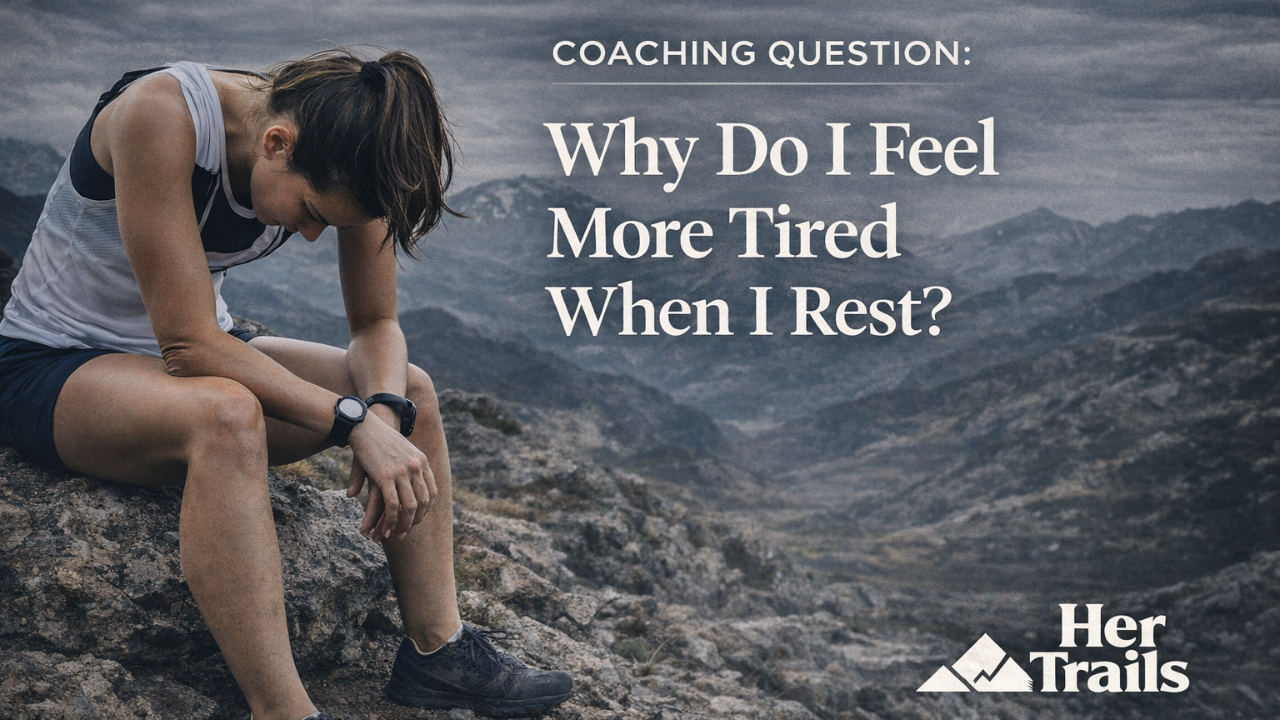
Q: I skipped a session and I feel more tired.
Coaching Question
“If resting made me feel worse,
should I have pushed through the run?”
A real question from a woman deep in a long trail build, navigating fatigue, recovery, and trust.
Trail Note
“I skipped the run and slept instead. Then I felt exhausted all day.”
This is a question we hear often in endurance training, particularly from women deep in a build phase.
Did I make the wrong call?
Should I have pushed through?
Why does my body sometimes feel worse when I don’t run?
When Rest Feels Heavier Than Training
For many endurance athletes, running isn’t just training. It’s regulation.
Movement supports circulation, nervous system balance, hormone signalling, and mental clarity. When that familiar stimulus is removed, the body sometimes takes the opportunity to drop into deeper recovery instead.
That exhaustion isn’t a sign you did something wrong. It’s often a sign your system finally felt safe enough to rest.
The Female Endurance Context
Women often carry layered load.
Training stress. Cognitive stress. Emotional labour. Hormonal fluctuations. Life logistics.
In long trail builds, fatigue doesn’t always show up as sore legs. It shows up as heavy limbs, brain fog, disrupted sleep, or an overwhelming urge to stop.
Skipping a session and feeling wiped afterwards is frequently a sign of cumulative load rather than a lack of fitness or commitment.
Base Miles Are a Tool, Not a Test
A Base Mile session exists to support consistency, aerobic development, and rhythm.
It is not there to override exhaustion.
In trail and sky marathon preparation, longevity matters more than any single run. One missed base session does not derail adaptation. Ignoring early fatigue signals often does.
Choosing sleep can still be a productive training decision.
What to Do When This Pattern Appears
When rest leaves you feeling flat rather than refreshed, it’s an invitation to observe rather than judge.
Sometimes, a short walk, gentle mobility, or low-intensity movement later in the day can help re-regulate energy without adding stress.
Other times, full rest is exactly what allows the system to reset.
The coaching work here is not about forcing an answer. It’s about noticing frequency, timing, and context.
Endurance Is Built Through Responsiveness
The strongest trail runners are not those who never rest.
They are the ones who can respond early, adjust intelligently, and stay connected to their bodies across long arcs of training.
Listening is not stepping back. It’s how you stay in the game.
A Coaching Reminder
Not every skipped run is avoidance.
Not every tired day needs fixing.
Patterns matter more than moments.
Endurance is built by those who know when to move, and when to let the body catch up.