
Buffalo Stampede 20km | 2026 Course Update
Her Trails Journal | Buffalo Stampede 20km
Buffalo Stampede 20km | 2026 Course Update
Single Track, the race organisers, have recently shared updates to the 2026 Buffalo Stampede 20km course. These changes reflect updated trail access and land availability, including the reopening of Clear Spot Ridge.
As many Her Trails athletes are currently training toward this event, we wanted to provide additional insight and clarity on what the updated course looks like on the ground and how your training is preparing you for it.
This trail note is intended to complement official race information with coaching context. Please check out all official information, and we encourage you to review the maps and upload the GPX file.
The 2026 Buffalo Stampede 20km is not a softened introduction to mountain racing. It is a compact alpine course with sustained climbing, technical descents, and very little free running.
At just under 20 kilometres with close to 1,400 metres of elevation gain, success (and enjoyment) on this course is less about raw speed and more about how efficiently you move uphill, how controlled you descend, and how consistently you manage effort as fatigue builds.
Understanding the shape of the course helps remove uncertainty and allows you to trust the work you have already done.
Understanding the 2026 Course
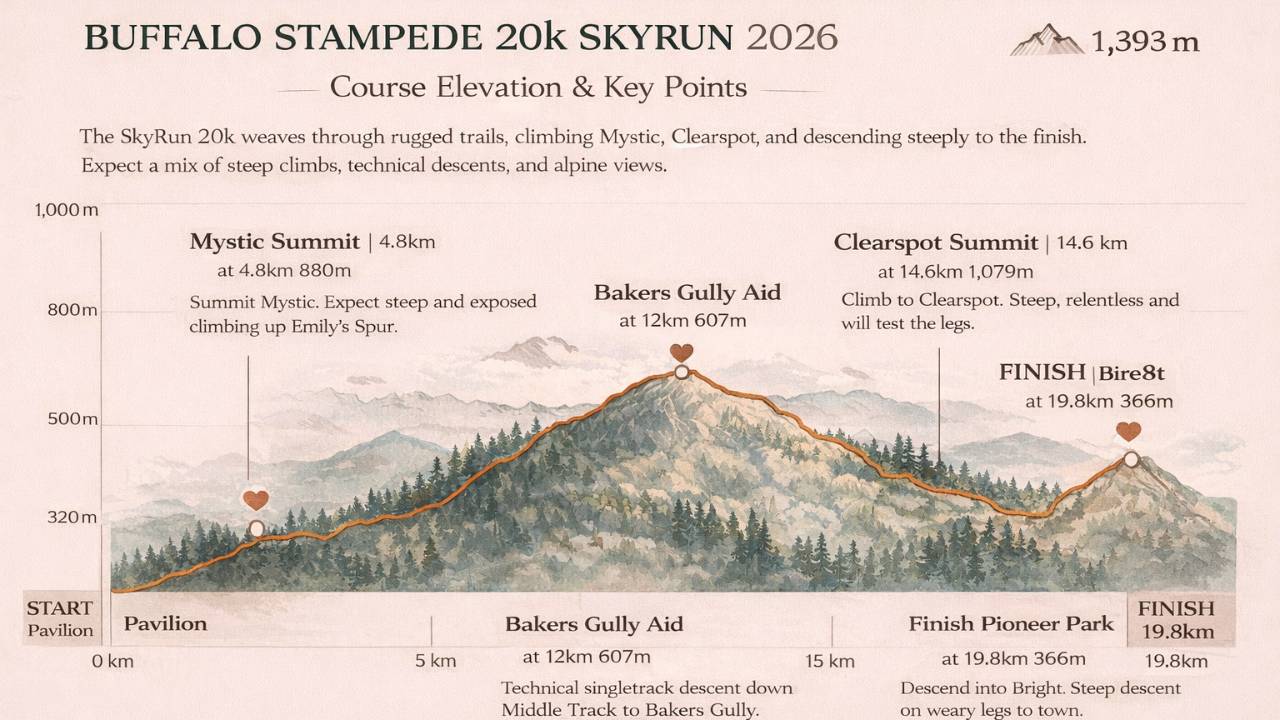
When you look at the 2026 course map and elevation profile, the race breaks into four clear phases.
Phase one: sustained climbing early. The opening kilometres begin climbing almost immediately. There is no long settling period. This is why your program has emphasised controlled uphill work and hiking efficiency rather than fast starts.
Phase two: uneven, honest terrain. After the first major climb and descent, the course does not offer true recovery. Effort remains steady even when the profile softens. This mirrors your longer steady sessions where the goal is consistency, not pace spikes.
Phase three: the decisive climb. The second major climb arrives when fatigue is already present. This is where upright posture, short steps, and rhythm matter more than strength. Your repeated climbing blocks and hiking practice are designed for this exact moment.
Phase four: technical descending to the finish. The final descent, including Middle Track, is steep and technical. It rewards athletes who can stay composed and move efficiently on tired legs. This is why downhill control, not just downhill speed, has been a focus in your training.
How Your Training Matches This Course
Your training has not been about chasing arbitrary numbers. It has been structured to meet the specific demands of this course.
Uphill efficiency. Long climbs, hiking intervals, and strength work support sustained output without burning matches early.
Effort control. Sessions that prioritise even effort over pace prepare you for a course where the terrain dictates speed.
Downhill resilience. Technical descents and leg-strength work build durability and coordination when fatigue is high.
Energy management. Practising fuelling during steady, demanding sessions prepares you to stay fuelled without relying on late corrections.
What to Carry Forward
The updated Buffalo Stampede 20km course does not require you to do more. It requires you to trust what you have already built. The training is designed for this terrain. The structure is intentional. Your job on race day is simply to move with patience, clarity, and respect for the course in front of you.