
Trail Movement Foundations
Training Notes · Trail Skills · Movement Foundations
Trail movement.
Foundations.
Why moving well over rough ground starts long before race day.
trail is a skill.
Technical trail running is often misunderstood as a fitness test. In practice, it is just as much a movement skill. The runner who moves well over rocky ground is not always the strongest or fastest athlete in the field.
More often, she is the one who has practised how to climb without overreaching, how to descend without braking through every stride, and how to place her feet with enough intention to stay efficient when the trail becomes rough.
This matters over ultra distance because wasted movement adds up. A slight loss of efficiency on one climb may feel minor. By the final third of a race, that same pattern can become a meaningful cost.
Trail efficiency is not about looking smooth. It is about using less energy to solve the terrain in front of you.
01 / Power hiking
Hiking is not a concession. It is a strategy.
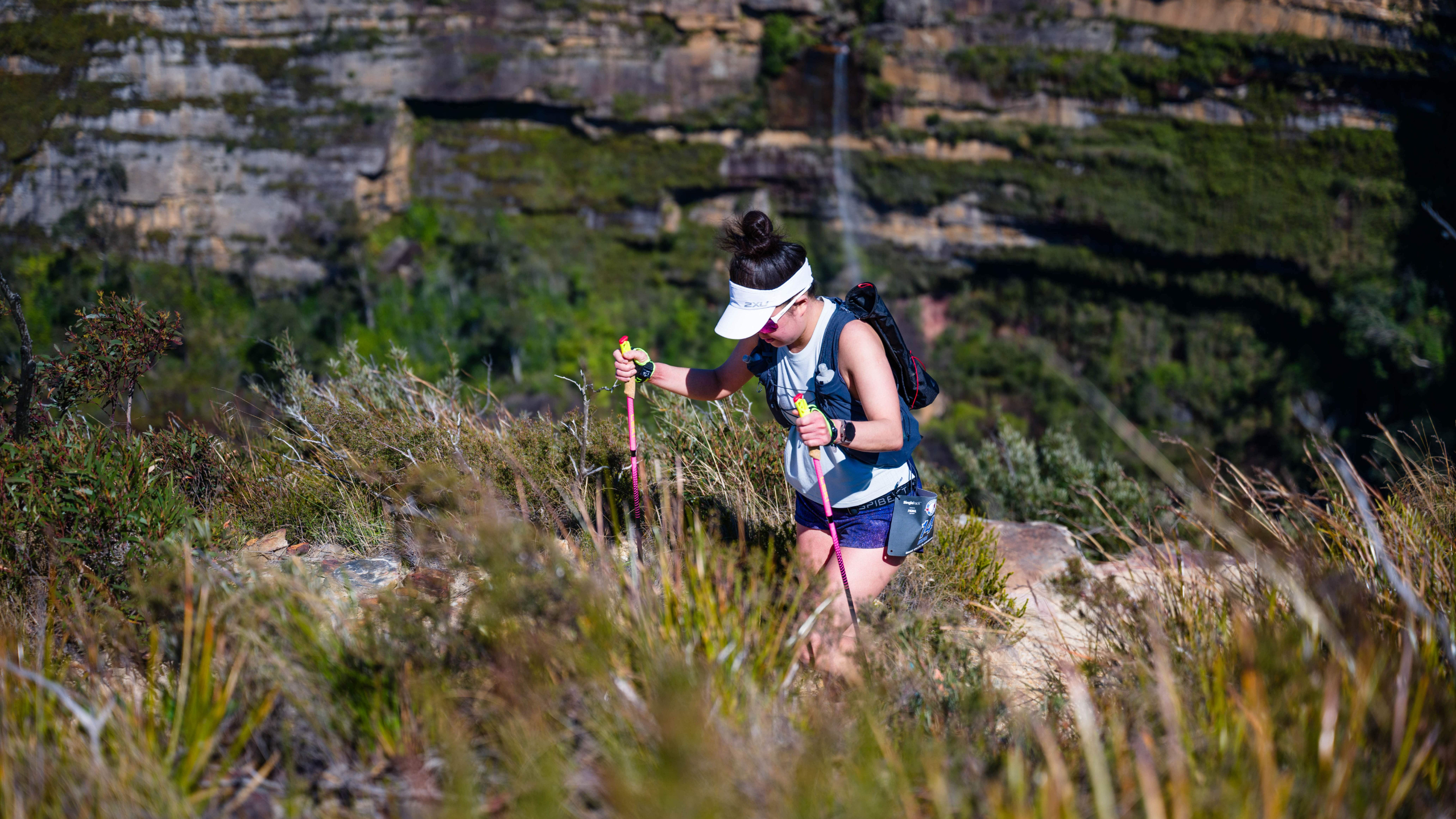
For many women moving into longer trail races, one of the biggest mindset shifts is recognising that hiking is not a sign of failing fitness. On steep grades, trying to run everything often creates unnecessary energy cost.
Research on uphill locomotion has shown that uphill walking economy is strongly related to trail running performance. Practical coaching has long observed the same thing. Once the grade is steep enough, hiking becomes more efficient than running, and the effort cost of forcing a run rises beyond what is sustainable across an ultra.
What efficient power hiking looks like
Short, quick steps
Compact strides rather than overreaching. The legs turn over. The hips stay tall.
Active arm drive
Hands either drive on the quads or swing with purpose. Arms set the rhythm, especially on steeper grades.
Tall chest, open breath
A small forward lean from the ankles, not a collapse at the hips. The chest stays open so breathing stays organised.
Sustainable rhythm
A pace you can hold without drifting too far above your working effort. Climbing well is climbing for hours, not minutes.
The transition point where hiking becomes smarter than running is personal. Practising both inside the same training block teaches the body where that line sits for you.
02 / Foot placement
Attention, not panic.
Technical terrain rewards attention. Not panic. Not stiffness. Attention. Recent research on uneven ground suggests that runners do not always need hyper-precise foot targeting to stay stable. The body adapts through leg stiffness and other mechanical responses.
But on real trails, deliberate attention still matters. Rocks, roots, mud, and camber all increase the consequence of poor choices when fatigue rises late in a long day. The useful skill is not obsessing over every step. It is learning to scan, choose, and trust.
A simple scan and step pattern
Scan two to three steps ahead
Eyes work in front of the feet. Reading the trail early gives the body time to choose well rather than react late.
Identify the stable options
Look for flat, dry, supportive spots. Not the perfect step. A good enough one.
Let the feet move with confidence
Trust what you have already seen. Hesitation often costs more energy than slowing down with intent.
For athletes who tend to freeze on technical ground, this scan and step pattern is the most reliable way to retrain the nervous system. Confidence is built through repetition, not pep talks.
03 / Descending
Where confidence is built or quietly lost.
Downhill running is where many runners either gain confidence or lose it. It is also where a great deal of muscular damage occurs. Recent reviews continue to show that downhill running places high eccentric load on the lower limbs, increases muscle damage markers, and contributes substantially to fatigue in long trail and ultra events.
That is why descending should be trained as a skill, not left to race day. The goal is not reckless speed. It is controlled momentum. The trail is going to go down whether you trust it or not. Better to arrive there prepared.
Four cues for controlled descending
Slight forward lean from the ankles
Hips stack over the feet. Leaning back digs the brakes in and overloads the quads.
Quick, light steps
Shorter steps, faster turnover. Long, reaching strides feel safer but increase impact and muscular load on every contact.
Relaxed arms and shoulders
Tension in the upper body locks the legs. Arms float to assist balance, not grip the air.
Less braking through the quads
Let gravity carry some of the work. Constant braking is what destroys legs by the end of a race.
Descending well is not about attacking the hill. It is about staying organised while the trail speeds up beneath you.
04 / Why now
Skill compounds the same way endurance does.
Week three of a build is not the time to chase mastery. It is the time to begin paying attention. Movement skills compound the same way endurance does. Repeating them in a low pressure training phase gives the body time to learn.
Over a longer build, that learning becomes economy. Economy becomes confidence. Confidence becomes the version of you that arrives at race day already familiar with what the trail will ask.
For women training around work, family, and the wider demands of life, this matters even more. Skill work is valuable because it improves performance without requiring every session to become harder. Sometimes the most useful progress does not come from pushing more. It comes from moving better.
05 / This week
Four small experiments.
Try one or all of these
01 / Practise a power hike
Include one sustained climb where you deliberately practise power hiking. Short steps, active arms, tall chest. Not a backup option. The plan.
02 / Make foot placement the focus
Choose one technical section and make foot placement your only focus. Scan, choose, step. Then repeat.
03 / Film a descent
Film yourself on a descent and watch your posture, stride length, and arm carriage. Information beats opinion every time.
04 / Find your transition point
Notice the moment running uphill stops feeling efficient and hiking becomes smarter. That point is your data, not a failure.
What feels awkward now often becomes automatic later. The movement patterns you practise early in training are the same ones that hold you together late in a race. That is the value of starting now.
06 / The shift
Moving better is its own form of training.
You do not need to be the strongest runner to be the most efficient one on the trail. Skill is its own form of training. Practised now, in quiet sessions with no pressure, it becomes the thing that holds your form together when the trail gets long, the legs get heavy, and the day asks more of you than you planned for.
move better, run longer.
Authored by
Her Trails Coaching